Showing posts with label A Nightmare on Elm Street. Show all posts

Monday, 14 October 2024

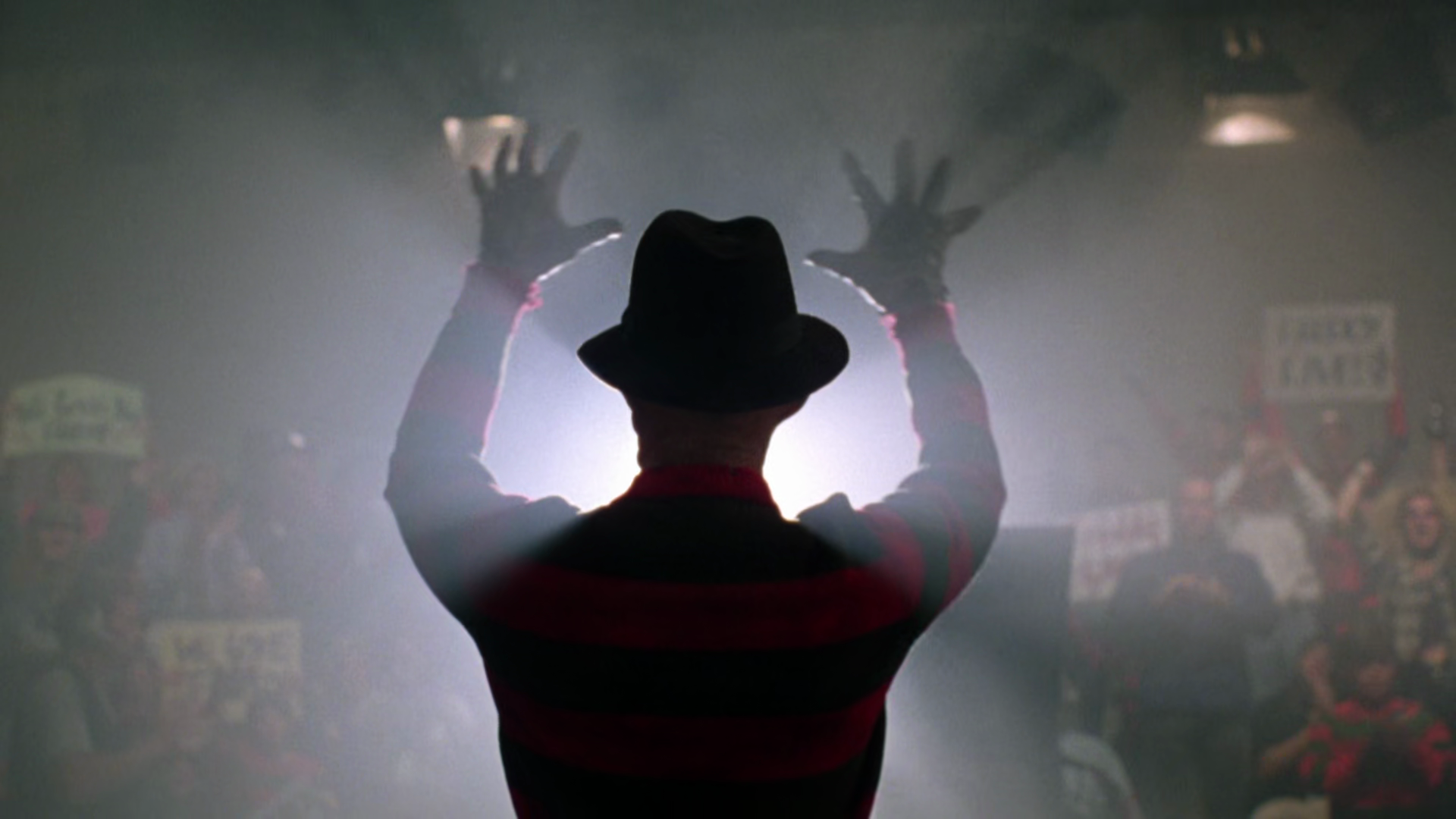
Freddy vs. Jason


Structurally and stylistically, Freddy vs. Jason is far closer to the A Nightmare on Elm Street side of its family than anything hailing from Camp Crystal Lake. So, as well as focusing on hallucinations and the special effects showcases they can facilitate, this film's prospective victims are much more emotionally damaged than the mosquito country regulars. Instead of stoner teens knowingly circling the drain, Freddy vs. Jason's cast are tranquilised, middle-class children; double-damned by parents who conjured up a vengeful ghost then lulled their offspring into an addled fog in their attempts to thwart it. This idea of unwilling subordination extends to the title characters as well, with Ken Kirzinger's Jason Voorhees tricked into the role of an understudy, toiling on behalf of a truly noxious interpretation of Freddy Krueger. 

As if to vanquish all memory of the quipping slasher that found purchase in 80s pop culture, Robert Englund's movie maniac is re-introduced in a sequence that elevates the paedophilic underpinning of the character from unspoken (but obvious) into vivid, repulsive text. It's not enough to imply that Krueger has murdered a little girl then cremated her body in his furnace, we have to see him licking a copy of her school portrait before stamping the image into his serial killer scrapbook. The uncomfortable darkness emanating from Krueger, which elsewhere demands that a father jab his tongue at his daughter's screaming mouth, is offset by the comparatively humdrum fantasies coursing through Jason Voorhees' skeletal remains. Six feet under, Jason dreams of chasing topless co-eds through endless woods, their flight thwarted by the kind of ineffectual motion found in real-life night terrors. 

In director Ronny Yu's film, Jason is a violent, lumbering expression of childhood helplessness. Even freed from memories in which this physically disabled boy is bullied to his death, Jason's feedback loop is one premised on expectation and denigration. His mother, a screeching phantom conjured by Krueger, screams at him to redress her own demise while Freddy himself is positioned as a repellent, patriarchal influence that demands Jason labour, thanklessly, for his new master's gain. Yu, a Hong Kong film industry veteran responsible for The Postman Strikes Back and The Bride with White Hair, approaches these creatures with neither the scraping awe of a fan or the bored indifference of a jobbing director. He's here to work, finding new perspectives on everything from the killers themselves to the steaming environments they inhabit. In one instance, when Krueger has an advantage over a soaked, cowering Jason, Yu and cinematographer Fred Murphy dial up the shadows then blasts Elm Street's broiled menace with greens, transforming Freddy into Margaret Hamilton's Wicked Witch of the West.

Similarly, the tracks of repetition that have been worn into Jason's decayed mind are framed here as almost Sisyphean in their monotonous and unending futility. While at the mercy of a gloating Krueger, Jason retreats into his safe space: imagining himself relentlessly gathering the bodies of brutalised, naked teens only to hurl these cadavers into an infinite void that lingers just beyond the confines of his well-stocked wardrobe. This en suite exists in the kind of comfortably well-off, suburban boy's bedroom that this engorged, single-parent child has, likely, never actually inhabited. A dream inside a dream then. For Jason the nascent twang of an adolescent sexuality - thwarted not only Jason's childhood death but by an overbearing, nagging mother - has curdled. The drive to embrace and hold onto someone has been transformed into something horrible and inhuman. Similarly, an idea of clashing objectives, to be expected in a film titled Freddy vs. Jason, is expressed here in stronger terms than a simple, blood-splattered battle. These two invincible sex criminals track in on this film's unusually unhappy cast (cosmetic surgery and substance abuse are recurring fascinations), each vying to be that special someone who will snuff out their miserable little lives. 
Friday, 14 April 2023

Wes Craven's New Nightmare


Comparatively restrained, especially for such a late sequel, Wes Craven's New Nightmare renounces tick 'em off teens to focus on torments with real weight and pain attached to them. This seventh outing for Fred Krueger defies its more formulaic predecessors by really spending time soaking in the anxieties and trauma generated by a killer who is, innately, supernatural. The marks he leaves demand to be explained away, to be attributed elsewhere by victims ashamed to even be considering this phantom's existence. Where previous instalments have careened from teenager to teenager - as they drift off towards oblivion - New Nightmare attaches itself to 30 year old actress Heather Langenkamp, playing herself as a widowed mother, as she slowly loses her grip on reality. Langenkamp, who starred as Nancy Thompson in the original A Nightmare on Elm Street, is assailed throughout New Nightmare by a variety of terrors that can be broadly defined by the tabloid-baiting idea of disreputable media having physical purchase in, and a pollutant effect upon, the real world.

This notion goes beyond a badly made up Robert Englund (this time wearing leather pants and sporting a plastic looking bone claw) crawling all over a hospital ceiling, dragging a bleeding babysitter behind him. Miko Hughes plays Langenkamp's son Dylan as a sleepwalking preschooler gripped by what appears to be sustained abuse; Craven's New Nightmare consciously forgoing the presentation of Krueger as the quipping serial killer of its immediate predecessors. Here he's monstrous in ways that defy deification. A series of telephone calls in which Langenkamp is taunted by Freddy culminates in an episode in which the phone receiver transforms into a tongue to lick Langenkamp's face while the voice at the other end of the line gloats that it has touched her child. Craven then does not shy away from the paedophilic aspect of his creation - this Krueger revels in the degradation and corruption of children. Indeed much of the New Nightmare's third-act is built around teams of nurses and paediatric doctors trying to separate a Freddy tainted Dylan from a mother who has, they believe, conjured up genuine obscenity by starring in a video nasty. New Nightmare pivots on the idea that, in the wider cultural conversation, these films - Craven's life's work - are often seen as so contentious as to be mind-altering. 

Tuesday, 1 October 2019

Freddy's Dead: The Final Nightmare


Freddy's Dead: The Final Nightmare proposes big ideas, using blip-blop computer readouts to place us in a near future where Freddy Krueger has grown strong enough to completely dominate his little corner of America. All of Springwood's children are dead, absorbed into the melted murderer after he's had his fun with them. This sinister Quickening has allowed Krueger a certain amount of power over the real world, blurring the lines between waking and dreaming life. In Fred's dominion the streets loop in on themselves, trapping visitors; the remaining, shell-shocked adults shuffle around dilapidated fairs, either hysterical at the sight of youth or lost to an unresponsive funk.

This idea, like many in Freddy's Dead, is really only a fleeting aside. Minutes burnt on the feature clock as the film churns on through other, only partially developed, sequel pitches. Freddy's Dead is to be a funeral after all. Why waste original thinking on that? To her credit, director Rachel Talalay does at least attempt to invest her film with momentum - actors hurl themselves into shot while the nightmare sequences that bleed into the film's reality are conducted with a manic, elasticated zeal. The real let down is the script, credited to Freddy's Nightmares writer and hotshot New Line producer Michael De Luca. No idea is adequately developed, the film doesn't feel designed, it's simply a series of half-hearted sketches pummelling their way towards a conclusion.

The one fragment of cohesion in the film arises from the unspoken bond between Lezlie Deane's Tracy and Lisa Zane's Maggie. They have both suffered under abusive fathers. When facing their demise, Freddy's Dead's male characters are tasked to struggle with a speculative impotence, typically the loss of complete physical control over their bodies. In contrast, the women are fed into night terror scenarios constructed out of trauma they have already experienced. They are being explicitly confronted with their past. Tracy is locked in a sweltering, cluttered apartment with her hulking, sexually aggressive father. No matter how she beats and pounds at his face, he still keeps rising for more. Maggie's dreams take her even deeper, trapping her in a forgotten life as Krueger's young daughter. She discovers her father's lair beneath their perfect, picket fenced house then watches, powerless, as her mother's head is dashed against the stairs leading to her tree house.

Saturday, 17 November 2018

A Nightmare on Elm Street 5: The Dream Child


A Nightmare on Elm Street 5: The Dream Child may be subject to the amnesiac, free-association plotting that drives the other Krueger sequels but screenwriter Leslie Bohem does remember to build his phantoms around experiences that are both recognisably part of teenage life and ripe for horrified embellishment. A Nightmare on Elm Street 4: The Dream Master survivors Alice and Dan are now high school sweethearts, surrounded by a fresh crop of pals and expecting their first child. Naturally Freddy sees this pre-college pregnancy as an opportunity to really turn the screws on Alice.

The expectant mother finds herself rapid-eyeing her way into the shit-stained asylum where Freddy was conceived. She experiences the child murderer's violent, repulsive conception in the first-person, trapped inside Sister Krueger's body as dozens of rabid criminals, including Robert Englund out of his third-degree burns make up, fall on her. Later she floats around on the periphery of Freddy's birth, witnessing a bizarre reconfiguring of history in which the unkillable paedophile dreams himself back into being as a flayed goblin. This new version of events is so startling that an attending Nun takes it upon herself to body slam this Dream Child into the nearest bin. Baby Freddy promptly escapes, demonstrating the wits and ambulatory expertise of a newly chest-burst Alien.

Unlike say The Dream Master, director Stephen Hopkins' follow-up keeps its characters defiantly one-dimensional. Alice's new friendship group are nothing more than a collection of bodies, ripe for the slaughter. Their thoughts and feelings are background radiation, filling in just enough detail to provide context for their deaths. Freddy's kills, when they arrive, frequently feel like the best possible use of these characters. This essential ambivalence allows the film's more morbid notes to sing. Funny book fan Mark is shredded in a nightmare sequence that mixes superstar comic aesthetics with A-ha's Take on Me music video. Dan's demise, in which he is forcibly transformed into a biomechanical carbuncle growing on the hide of a speeding motorbike, has the deranged, diesel powered energy of Japanese cyberpunk.

Thursday, 8 November 2018

A Nightmare on Elm Street 4: The Dream Master


Considering the Elm Street series is built on the idea of a disfigured nonce entering children's dreams to murder them, it's no surprise that the films have an elastic relationship with reality. Victims slip in and out of the dream realm to be prodded and abused by Robert Englund's increasingly flamboyant boogieman, while clairvoyant teens are able to build themselves super-identities out of the damned spirits haunting these planes. Formula firmly in place, A Nightmare on Elm Street 4: The Dream Master rambles around with a new set of young adults, mechanically embedding character specific dangers before callously offing them with bravura make-up effects.

The Dream Master's attempts to play with the Elm Street recipe are a mixed bag. Showing unwilling allies forcibly hurled into REM sleep to placate a psychic's night terrors neatly combines the anxiety of sequel survivors with a refresher on the forces opposing crispy Fred. That the film rushes to mangle these A Nightmare on Elm Street 3: Dream Warriors leftovers (Patricia Arquette's steely psychic Kristen Parker is reduced to a one-note shrieker by her replacement Tuesday Knight) with very little ceremony leaves large sections of the film circling the drain. Eventually Dream Master settles on Lisa Wilcox's Alice, a lucid dreamer well-placed to turn the tables on Krueger.

Alice daydreams through the difficulties of her waking life, be that plucking up the courage to tell the school hunk how she feels about him or putting a drunken, abusive father in his place. Her blips of directed unreality invite another sense of uncertainty into the film, promising a variety of attack that never quite comes together. Although it's expected that scenes will bubble along with the looping chaos of nighttime fantasy, Renny Harlin's film dwells on the method and delivery of Freddy's assaults to the exclusion of anything else. By extending the murders, so the audience can luxuriate in the special effects, Dream Master trades shocks for revulsion, using Kreuger not as terrifying spectre but the wisecracking MC walking us through the latest prosthetic showcase. This imbalance is compounded by the gentleness and general likeability of Fred's newest victims. These young girls aren't attacking him or each other, they're just kids getting on with their lives. Their slaughter therefore registers as mean-spirited or, in at least one case, outright repulsive.

Wednesday, 31 October 2018

A Nightmare on Elm Street 3: Dream Warriors


Continuing a series trend for sympathetic depictions of its teenage victims, A Nightmare on Elm Street 3: Dream Warriors takes place in a psychiatric unit for troubled children. Chuck Russell's film, working from a screenplay credited to Russell, Bruce Wagner, Frank Darabont and franchise creator Wes Craven, doesn't attempt to damn these adolescents for the damage they've experienced or visited upon themselves. In that sense Dream Warriors stands apart from the usually prudish morality of a genre that often attempts to massage large-scale evisceration with unlikable, even bullying personalities.

Heather Langenkamp returns as A Nightmare on Elm Street survivor Nancy Thompson, sporting a traumatic shock of white in her hair and working as a therapist for the young patients. Nancy rallies the besieged kids, using Patricia Arquette's Kristen as a psychic anchor in their fight back against vile old Fred Krueger. Not only is Dream Warriors unwilling to condemn its mixed-up cast, it also allows them to push back against the sins of their parents, using weapons derived from the moral panics of suburban America. Disabled hobbyist Will uses his Dungeons & Dragons knowledge to attack Freddy with arcs of Elfen magic while former drug addict Taryn dreams herself as a punked-out street tough, able to fight and navigate the kind of alleyways in which she previously felt addled and helpless.

A Nightmare on Elm Street Part 2: Freddy's Revenge


Jack Sholder's follow-up to A Nightmare on Elm Street largely dispenses with the idea that Freddy simply rules the dream realm. The disfigured child killer lingers like abuse, bubbling up in sensitive young men and using their confusion as his bridge into reality. It's five years after the first film, Jesse Walsh and his family have moved into Nancy Thompson's barred-up murder house. Freddy's memory persists like background radiation, turning the home into an oven and still powerful enough to detonate toasters and parakeets at will. Jesse cooks in his packed-up just-moved-in bedroom, unable to sleep lest he slip back onto Krueger's runaway school bus.

A Nightmare on Elm Street Part 2: Freddy's Revenge takes a different approach to the teen slasher, swapping out the attractive girl next door for Mark Patton's Jesse Walsh, a spaced-out wanderer trying to work out who he is and what he wants. Jesse isn't your typical horror male, he isn't confident or braggadocious, he's intense but vulnerable. The personal possessions he has pointedly little interest in unpacking play like a sports focused veneer, a cover he built for himself in his old life that he no longer has the energy to maintain. Disconnected from his overbearing, boorish father and his smile-at-all-costs mother, its Jesse's friendships that provide the greatest insight into who he is.

Jesse rolls around on the ground with school bully Grady, a mouth-breather who pulls down Jesse's sweatpants when the less chiselled boy stands to score himself some athletic achievement. That the two enjoy lunch and chit-chats together afterwards speaks to something flirty and unacknowledged between them. Grady even acts as a gatekeeper for Jesse, warning him about the gym teacher's leather daddy private life as well as his unprofessional desire for teenage pretty boys. Jesse keeps his closest female friend, little rich girl Lisa, at arms length despite her obvious romantic interest in him. When they do, finally, creep towards a physical relationship, Jesse acts out his idea of carnal desire before retreating, disgusted by the obscene, lubed-up changes to his body. Freddy prays on Jesse's sexual uncertainty, testing what the teenager is willing to consume, or be consumed by, with deliberately illogical scenarios that blur the line between dream and waking life within the film.

Friday, 22 July 2011

"Kung Fu this, bitch!"


Mortal Kombat gets its last DLC pugilist, Mr Fred Krueger from A Nightmare on Elm Street. Aside from a few familiar grunts, this Freddy's unusually taciturn. I can't quite place which iteration of Freddy this is supposed to be. Robert Englund's day-glo sequel quipper? Or Jackie Earle Haley's more recent Platinum Dunes de-think? Given the character's noseless, action-figure-left-in-the-sun appearance, probably the latter. Far be it from me to pour scorn on a purely bonkers corporate mash-up, but wouldn't it be cooler if Freddy screamed zippy New Line abuse whilst slash-handing his opponents?