Showing posts with label this is how it ends. Show all posts

Sunday, 14 December 2008

This Is How It Ends: Transformers: The Headmasters


Phew! Finally got through all 35 episodes of Japan exclusive Transformers animation series: The Headmasters. Despite my earlier assurances, an overarching plot does begin to develop in the last third: new line headliner Mega Zarak has his heart set on blowing Earth up good. The Autobots are simply appalled at his vulgarity.

Here's a brief rundown. After the complete destruction of Cybertron - which Galvatron manages to survive, despite being at planet-tearing ground zero - the new toys faff about the Galaxy being boring. Galvatron eventually dies by falling off an iceberg, paving the way for Zarak's slowburn reign of terror. New characters are introduced every other week (mostly evil ones weirdly - Japan's notorious for slighting baddie toys), with formerly bee's knees cool characters regulated to bumbling idiocy. The Decepticons at least attempt to raise a smile by exterminating any race they happen upon, but throughout the middle chunk it's all deathly dull planet hopping. Ho hum! Thankfully the show goes Giant Robot Show trope mental in the final third; super weapons, counter super weapons, power of friendship conquering all: the works. Best of all is the sublimely ridiculous notion that Decepticon Ninja bastard Sixshot secretly has a heart of gold. Stranded on an asteroid with Movie brat Daniel, Sixshot decides to do a Piccolo, becoming bestest friends forever with the simpering tween. He's a professional see? This intergalactic war thing's just his day job!

By series end Sixshot is through with the backstabbing Decepticons, taking up a new role as Daniel's unseen lethal protector. Any bot who gives the child grief gets a right ninja thumping. This daffy turn of events is made even more excellent by the fact that Sixshot is easily the most psychotically capable Decepticon throughout the series.


He's a Decepticon's Decepticon if you will.

Sixshot's season wide crimes include: murdering two tiny child like friends of Chromedome for laughs; kidnapping and torturing kid friendly sidekick Wheelie; and most dastardly of all: killing the shit out of Autobot Earth commander Ultra Magnus! Remember him from The Movie? He got no Matrix of Leadership love. Sixshot bombards the unlucky Autobot with tons of laser fire until Magnus trips over all perished. Ouch! Sixshot does a cackle and flies off. In a series were all the other Decepticons end up all mouth and no trousers, Sixshot stands triumphant: no mouth, and absolutely loads of trousers thank you very much.

Wednesday, 9 July 2008

This Is How It Ends: Galvatron


Born from the battered remains of Megatron, and nursed by an all-consuming Satan planet, Galvatron stole all our hearts in the 1986 classic Transformers The Movie.

Treacherous, murderous, and ruthlessly dicky; Galvatron spent his introductory film entry moping about his Faustian bondage pact. Nominally created to rid doom-globe Unicron of his Achilles heel - the Autobot Creation Matrix - Galvatron instead seized the artifact for himself, turning on his chubby master. Unicron retaliated by transforming into a million storey tall Lucifer-bot and eating his slave. Galvatron survived this feasting only to be soundly thumped and cast out into deep space by a transcending Autobot do-gooder. Curse and confound it all!

Galvatron spent the years between The Movie and Transformers Season 3 trapped in a lava swamp. A tragic state of affairs that caused him to turn inept and mental. A shadow of his former self, Galvatron muddled about future year 2010 beating up his subordinates and failing to trounce interim leader bot Rodimus Prime. Last seen in the US TV series finale falling into space, Galvatron had a brief lease of life in the Japan only animated TV series Transformers: Headmasters.


This is were our glorious hero met his doom.

Cornered on an ice flow by the despicable Autobot Headmasters, Galvatron was eventually seen off by a bizarre sentai form-up that saw the four strong goody task force holding hands, floating in mid-air, and violently expelling white hot plasma blasts. What an affront!

At least he went down fighting (and it basically took the entirety of the hero cast to do him in)!

Galvatron! This is how it ends: See the whole sorry episode here.

Goodbye Emperor of Destruction!

But wait! Although that was the last we saw of Galvatron, in a TV mag exclusive manga / full colour spread series: Battlestars: The Return of Convoy, his carcass was found and revived by yet another interstellar leach-form. This time Dark Nova reformatted his slave herald into an ultra powerful version of former persona Megatron.

Super Megatron
was born!

Sunday, 8 June 2008

This, On The Other Hand, Is Definitely Not How It Ends: Big Boss Part 3


The Kojima-less NES port of Metal Gear sold extremely well outside of Japan. It shifted over a million copies in North America alone. Konami sought to generate extra coin by putting together a more action orientated sequel specifically for the Western market: Snake's Revenge! Never officially regarded as part of the 'official' series, Snake's Revenge is the red-haired step child of the Metal Gear family. It's widely hated, although not widely played. Again, it's the story of Solid Snake (now known as the double ranked Lieutenant Solid Snake) infiltrating a wonkily aggressive nation that purport to have a disaster weapon.

Snake gets two allies this time, John Turner and Nick Myer.


Both trot off and promptly get themselves dead. No help what-so-ever. Lt. Snake battles on. In an red jumpsuit. With jaundiced skin. Sneaky! There's even side-scrolling spam sections. Upset the faithful!

Big Boss pops up at the end. The Cobra Commander look alike spouts some perfunctory revenge speak, then gets his run and spam on. Shoot him enough and he does an explode and mutates into a twenty foot tall death-bot. Oh my giddy aunt!

"Ha, ha, ha! I have no weak point you can penetrate."

Quite. At this point you're absolutely sunk unless you immediately hightail, and are packing landmines. See the whole sorry / awesome episode here. Me likes!

After all that Snake storms off to shoot rockets through a tunnel system at a stationary Metal Gear Mark 2. Glowing weak spot!

Despite everyone hating Snake's Revenge, Kojima seems fairly pleased with it. He's quoted as saying it's a faithful sequel. He's still down on the NES version of the original though. Ah man. Don't get him started. He hates them damn life-draining dogs in the tacked-on Jungle entry point. Who can blame him? They suck!

Credits! See our hero smile!

Saturday, 7 June 2008

This Is How It Ends: Big Boss Part 2


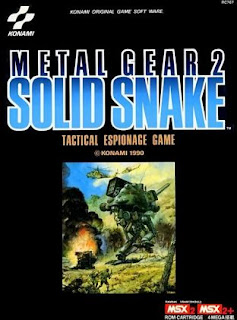
1990 saw the MSX2 exclusive release of Hideo Kojima's follow-up to his sneak classic Metal Gear: Metal Gear 2: Solid Snake. Solid Snake is plucked out of his Canadian wilderness retirement to infiltrate the fictional Central Asian country of Zanzibar Land, again, controlled by Freudian nasty pop: Big Boss.


How did Big Boss survive Outer Heaven's destruction? We're never told. He's just wily like that. Accept it! Rescued hostages recount to Snake that Boss may no longer be entirely human either; sly allusions to Kojima's synthetic human point and clicker game: Snatcher, and his RoboCop-esque fate in unofficial Western market only sequel: Snake's Revenge abound during in-game Codec calls.


Seizing control of the fictional country, Big Boss recruits war orphans from all over the world to be molded and raised in his image; the foundation for a great military empire that will venerate and honour their warriors. In order to create this techno-Sparta, Big Boss has captured several tinker-king scientists, and commissioned another Cold War tipping nuclear tank: Metal Gear D. It's Snake's job to blow everything up and rescue the hostages.


Sounds simple eh? It isn't. Clear cut good and evil? Nope. The first boss Snake encounters on his sneak mission is disguise master ninja: Black Color. Black Color is the last remaining member of a NASA special forces unit created to fight in extraterrestrial environments (fight them Chinese on the Moon!), cybernetically enhanced and doped up to the eyeballs; Black Color teleports and hurls shurikans in a psychotic froth. Upon defeating this cyborg menace it is revealed that your enemy is none other than Kyle Schneider, an ally from the previous game.


Schneider was snatched up against his will surely? He fought alongside you against Big Boss in the previous game! He hated Outer Heaven! Schneider reveals that after Snake successfully completed the first game's mission, NATO carpet bombed the entire area to nothing. Their goal was to wipe out everything to do with Outer Heaven - including Schneider's resistance army. Schneider was captured and subjected to torture ascension implants for a short-lived experimental space combat unit. NASA disbanded the unit for being too cool, and Schneider managed to escape the purge. He was offered sanctuary in Zanzibar Land and took it, growing to admire his former enemy, primarily for taking in all survivors of the Outer Heaven incident - including resistance members. These are the actions of the 'bad-guy'.

Tune in about 5:45 - This is how it ends for Kyle Schneider.

This is a common theme throughout the Metal Gear series: Big Boss as a champion of the downtrodden. In Metal Gear Solid, Kurdish guerrilla Sniper Wolf considers Big Boss to be a hero. She recounts her life as a child soldier and her eventual rescue and molding by Big Boss. She calls him Saladin, after the 12th century Muslim political and military leader.


Is Snake's mission just? Or just a loyalty bending wetwork clean-up? Wouldn't it be better to let Big Boss live and really stick it to the corrupt Western powers? Following the character's gross disillusion with the US at Metal Gear Solid 3's conclusion, it looked like this was precisely the line of thought going to be expressed in the PSP spin-off Portable Ops, especially considering the announced recruitment mechanic. Sadly that didn't quite happen - instead you formed the FOXHOUND unit from the ground up to combat your gone rogue predecessors. Ah well.


Schneider aside, another former comrade sympathetic to Big Boss' agenda is Frank Jaeger / Gray Fox / Null. Phew!


Jaeger was the FOXHOUND agent originally assigned to infiltrate Outer Heaven, his failure ensured the re-assigning of new recruit: Solid Snake. Following the destruction of the Metal Gear tank and the fortress nation, Jaeger absconded with Big Boss, deserting his former unit. Jaeger became Boss' right hand man, leading the specialist Dogs of War unit, and piloting Metal Gear D during the second game's conclusion.


This is (sort of) how it ends for Frank Jaeger: A one on one fist fight in a minefield.

Jaeger'd be back as a cyborg ninja too. A recurrent fate for Snake's soldier friends.

Anyway, I'm getting way off the point. This is all dressing. This a Big Boss article after all. It's hard not to get sidetracked by Metal Gear 2: Solid Snake. The more I see and read of the game, the richer it seems. See? It's happened again. More than being a template for the subsequent Metal Gear Solid series, it neatly comments on, and upturns our assumptions on who these characters are / were their loyalties lie. In that sense it has much in common with Metal Gear Solid 2: Sons of Liberty, MGS2's relationship with Metal Gear Solid is almost post-modernist deconstruction. Snake is largely abscent, and your left with blonde doll Raiden as he muddles through a samey adventure, that eventually turns this (minute) shortcoming into central text: a despotic AI system specifically engineered the situation to be an exact replica of the previous game to create another, more pliant, super soldier. Literal cloning had failed, so now psychological conditioning was the order of the day. In Metal Gear 2: Solid Snake friends are enemies, and enemies are philanthropists.

So how does Big Boss finally get it once and for all?

During your fight with Grey Fox your backpack is set aflame forcing you to ditch all your weapons / supplies. You muddle down a dark corridor, tech-naked, to tackle your ex-commander / retcon clone father. Big Boss chases you (using doors!) around a maze of rooms as you desperately try to find something, anything to take him on with. Tense, haphazard and overwhelmingly unfair - it's a fitting end to the original series.


This is how it ends: Solid Snake's final battle with Big Boss.

Come the Solid series, Big Boss would be recast several more times. His phantom spectre looms over the first installment, the Liquid son attempts to fulfil his dream of a soldier paradise - even invoking the mantra name: Outer Heaven. The Liquid son also demands the return of the retrieved and cryo-frozen father's body - he wants to harvest it for soldier genes and mutate his faceless guinea pig army.


Sons of Liberty visually introduces a third 'perfect' clone son: Solidus (the state between a liquid and a solid), the image of the father. Codenamed King and a former President of the United States, Solidus is still just a puppet outmaneuvered and manipulated by the Solid series' unseen esoteric antagonists: The Patriots. Both these sons are unable to pass beyond legacy aspirations, and are undone by legacy oversights: discarded family. Respectively: the Solid son and Raiden - Solidus' literal adopted son, and the product of Solidus' small boy unit - assigned to the Liberian civil war. It'll be interesting to see if Metal Gear Solid 4 recons Patriot involvement / aggression onto either the Outer Heaven or Zanzibar Land incidents, perhaps the garrison countries were built to stand against their meme plutocracy?


Big Boss features in the third Solid game, this time as the hero. Cast into the midst of a Cold War favour plot a young Big Boss, codenamed: Naked Snake must rescue a scientist, destroy a bastard nuclear tank, and murder his mentor / lover - who has defected to the USSR.


Starting out as a patriotic taciturn green beret, by game's close Naked Snake is deeply dissatisfied with his soldier's lot. Even going as far as snubbing the director general of the CIA during his 'crowning' ceremony. As it turns out the mission has very little to do with heroism and everything to do with a secret unclaimed slush fund belonging to a group of self-proclaimed Philosophers, the renegade American branch of which would become the AI overlord entity: The Patriots.


All the little Snake toys dance to their merry jig.

Wednesday, 4 June 2008

This Is How It Ends: Big Boss Part 1


He looks so care free. Standing there, whoring a Japanese gelatin energy supplement. Simpler times.

Who knew that thirty years down the road he'd have one less eye, a nuclear-tank kingdom, and a clone offspring attacking him? Poor Big Boss. With Metal Gear Solid 4: Guns of the Patriots a little over a week away (be still my beating heart), it seems appropriate to have a little (minute really) look at the oft-forgotten portion of the Metal Gear series - the two pre-Solid MSX releases - and how they wrapped up the life of sometime series protagonist: Big Boss.

Set in disaster year 19XX; 1987's Metal Gear saw rookie special forces shitkicker Solid Snake infiltrating garrison country: Outer Heaven. Tasked with destroying a walking mecha-tank capable of launching ICBM's from any terrain, our hero receives intel throughout from FOXHOUND unit commander Big Boss. Towards the end of the game Big Boss' information begins to willfully mislead the player, endangering Snake. Oh no! Big Boss is later revealed to be the brains behind Outer Heaven, Snake's mission being little more than a training / misinformation exercise that has become too successful.


The years had not been kind.

This isn't quite how it ends: Metal Gear's final confrontation sees Big Boss battling his successor in the apocalypse countdown remains of his soldier empire. After Snake trashes the inoperable Metal Gear TX-55, he makes his way through a grim prison cell like warehouse and confronts his betrayer. Big Boss is dispatched with little fan-fair. He just sort of explodes and disappears. Interestingly no mentions are made of any biological link between Snake and Boss - an anti-development that was retconned for the first of the Solid series.


If the above video wets your appetite, why not have a crack at the bundled update of Metal Gear in the Metal Gear Solid 3: Subsistence set? You'll regret you did! Not because of any lapse in quality, rather because it is 8-bit unforgivingly tough. It does not want you to win!

Failing that there's a truncated NES version floating around, Kojima himself tactfully describes it as "complete garbage". It's this version that was bundled with the Japanese Metal Gear Solid: The Twin Snakes Gamecube console set. Check out Michael Biehn on the cover!


In the US version of the NES release, Big Boss suffered the indignity of being rechristened: Colonel Vermon CaTaffy by the snarky pack-in manual. Topical!

Death and several nuclear scale explosions didn't slow wily old Big Boss down though, he'd be back for both a 'true' Hideo Kojima helmed follow-up, and an action orientated sequel sop for Western audiences. Hooray! Look out for Part 2 tomorrow. It will follow much the same pattern.

Monday, 2 June 2008

This Is How It Ends: Thunderbirds

After forty years, thirty two TV episodes, two spin-off Supermarionation movies, a Japanese animated series, and a Commander Riker big screen balls up: This is how Thunderbirds ends. This is how The Hood is undone. The triviality of the circumstances have a grim ring of truth about them. We come to mourn you Mighty Hood! May your bizarre Fu Manchu eyebrows blossom in hell.