
Thursday, 24 March 2022
Wednesday, 23 March 2022
Tuesday, 22 March 2022
Spider-Man: No Way Home

Heavily indebted to Bob Persichetti, Peter Ramsey and Rodney Rothman's excellent Spider-Man: Into the Spider-Verse, Jon Watt's multi-dimensional pile-up, Spider-Man: No Way Home, employs the same reality-bending as its animated predecessor - not to mention the current Marvel streaming shows - to give this increasingly disconnected sub-series (as well as long-time executive producer Avi Arad) a victory lap. In doing so, No Way Home batters Tom Holland's likeable take on Peter Parker out of his moneyed comfort zone to re-establish a balancing act minted in a previous Spidey phase. The film abandons the overloaded technological wish-fulfilment - that saw Spider-Man subordinated into the role of Iron Man's teenage ward - to push at the working class ache that underpinned Sam Raimi's take on the character. No Way Home drags in adversaries from these Raimi films, as well as the two Marc Webb instalments that followed, as a way to brute force Holland's Parker through this conceptual shake-up.
No Way Home is a piecemeal experience then. Strange highlights - imported from different films and deployed to wrinkle recognition - struggle to exert themselves on a whole that seems to be either thrashing around in the midst of an onscreen identity crisis or simply holding the Spider-Man character to ransom ahead of the next round of financier negotiations. Willem Dafoe's Green Goblin is an obvious but under-explored delight though. The character's trajectory built around the tensions of a personality split that, unfortunately, we barely see overlap. Still, even if No Way Home doesn't apportion enough screentime to Osborn to manufacture a believable (or even trackable) sense of mounting disquiet, the film does remember that the action in the first Spider-Man's was defined by a deeply personal strain of violence. While the weight that Watts and his screenwriters (Chris McKenna and Erik Sommers) heap on their hero never comes close to matching the face-swelling welts that Raimi dished out, Holland does get to play murderous rage: punch after punch, hammering down on the teeth of a clearly ecstatic Goblin. For a series of films in which (comfortably) billions of people have died, the motivational power of pure hatred is a note that has been largely absent.

Wednesday, 16 March 2022
The Comics Journal - Fist of the North Star Volumes 1-4

Jumped at the chance to write about the first four volumes of Viz's recent Signature releases of Fist of the North Star for The Comics Journal. If you're not familiar with Buronson and Tetsuo Hara's series, expect muscular messiahs battling for supremacy in the ruins of the twentieth century.
Thursday, 10 March 2022
Wednesday, 9 March 2022

Sunday, 6 March 2022
Wednesday, 2 March 2022
Texas Chainsaw Massacre

Pitched as a belated continuation of Tobe Hooper's The Texas Chain Saw Massacre, David Blue Garcia's Texas Chainsaw Massacre - itself the ninth entry in this petrol-powered series - betrays little understanding of the original masterpiece as anything other than a vehicle for a stylised ogre to murder young people. Legendary Pictures' approach then is similar to the increasingly disconnected Friday the 13th sequels; a vague idea of continuity that, in truth, has been boiled down to the recurring threat generated by looming musculature with an affinity for power tools. Garcia's film - screenplay credited to Chris Thomas Devlin with story credits going to Rodo Sayagues and producer Fede Álvarez - also finds a couple of spare minutes to lift the avenging final girl conceit underpinning the recent refresh of the Halloween franchise. Sally Hardesty, the only survivor of the 1974 incident, has bounced back from what looked like a lifelong catatonic episode to show up, mid-mulch, for an unsatisfying third-act fumble.
Although no big shakes themselves, David Gordon Green's films do at least apportion a significant amount of their run-time to understanding the damage experienced by their heroines. Comparatively, this Massacre goes out of its way to snub Olwen Fouéré's take on Sally, reducing her to a clumsy emissary of the Remington Arms company. Largely contrived and mechanical in its execution, this Texas Chainsaw Massacre does manage a healthy thrum when we are allowed to see Leatherface rattling around in his private moments. One bystander, as they struggle to free themselves from a totalled police van, witnesses Bubba violently reclaiming the motherly mask intrinsically linked to his atrophied super-identity. Back in the home that has sheltered him in the intervening decades, a different victim watches as this killer attempts to process loss by staking a claim on his warden's clothing and make-up. These scenes are as close as Massacre number 9 gets to the trophy gathering predilections of Ed Gein, the necrophiliac body snatcher who served as inspiration for Hooper's nightmarish classic.
Tuesday, 1 March 2022
Wednesday, 23 February 2022
Monday, 21 February 2022
Memoria

Tilda Swinton's Jessica find herself in Colombia, visiting her sick sister (who believes she's bed-ridden as recompense for some unsourceable transgression) and making half-hearted enquiries about refrigeration units for a barely noted orchid business. Jessica's attempts to sleep in this new environment are thwarted by an unprompted crack that she later describes to a helpful audio engineer as sounding like a rumble from the core of the earth. Although we are shown specific circumstances in which only Jessica can hear these intrusive reverberations, they do seem able to exert some purchase on the physical world - at least enough, in one instance, to elicit a chorus of car alarms. Jessica represents an alien element in the film's opening passages; a person rudely imported into this milieu who, nevertheless, is slowly slipping out of alignment with her own world and disappearing into this one.
Apichatpong Weerasethakul's Memoria is built out of held frames, the director and his cinematographer Sayombhu Mukdeeprom using a flattened space, unmotivated by camera movement, to create vignettes. Swinton creeps across these frames. Her Jessica is always reticent, a trespasser slowly prodding further and further into places they don't seem convinced they should be occupying. Weerasethakul also cranks up diegetic sound far beyond typically acceptable levels; the hums and rumbles directing the eye to a detailing that gradually swallows Jessica up. The audience is prodded to tune into this stillness, understanding these rhythms as extant incident rather than a plotted bread crumb. Weerasethakul never betrays this somnolent trust either; he allows his audience to abandon their search for obvious meaning or direction, sinking into scenes and situations to the extent that they are then able to conjure up a sense memory - a smell, maybe - associated with their own experience of having existed within similar moments.

Sunday, 20 February 2022
Star Trek Generations

With the majority of the original Star Trek cast shuffled off into obsolescence after Star Trek VI: The Undiscovered Country, it falls to the cast and crew of television's Star Trek: The Next Generation to keep Paramount's gravy train rolling. Not that the film studio has any confidence in the ability of Patrick Stewart and pals to immediately grab a big screen audience's attention. Just in case movie goers hadn't been keeping up with the multi-season adventures of Picard and Data on TV, Star Trek Generations is bookended by sequences built around the incredible bravery of William Shatner's Kirk. A proven box office draw. The Enterprise's most famous captain sacrifices his unnaturally extended life, not once, but twice while attempting to upset the genocidal machinations of Malcolm McDowell's crazed scientist. Comparatively, Stewart's Jean-Luc Picard is introduced in the midst of a strained, holographic fantasy.
Captain Picard heads up a pompous haze in which the Next Generation crew have stepped away from their incredibly important daily duties in order to spend an afternoon standing around as 19th century sailors. No doubt designed to inspire a sense of nautical whimsy, the sequence instead has the brutal thrum of a workplace team-building exercise. One that, in truth, simply caters to the head honcho's desire to dress up and preen rather than build any actual interdepartmental connection. Screenwriters Ronald D Moore and Brannon Braga double down on Picard's strange pretensions when building the benign prison he experiences after being sucked into The Nexus, an ill-defined cosmic phenomenon that bombards sentient beings with wish-fulfilment. Kirk, when sucked into this intergalactic energy ribbon, decodes his failings; intruding on key moments from his recent past in an attempt to build a lasting connection with a woman - he's realised all too late - that he loves. Picard's emotional lock-up is empty and bizarre when measured against these all too real regrets. He sees himself as a minor lord in a Dickensian Christmas scene, one with almost nothing in common with any of Jean-Luc's actual, lived experience.
Friday, 18 February 2022
Thursday, 17 February 2022

Monday, 14 February 2022
Star Trek VI: The Undiscovered Country
Nicholas Meyer's previous crack at Gene Roddenberry's science fiction series - Star Trek II: The Wrath of Khan - introduced the idea of Starfleet cadets being trained, on enormous holodecks, to navigate a no-win scenario as a way of testing how they might react under incredible pressure. In that film, Kirstie Alley's Vulcan prodigy Saavik voices her frustration at being forced into a situation where, apparently, there is no correct answer. Later on in Wrath we discover that William Shatner's Captain Kirk had previously beaten this Kobayashi Maru simulation, doing so after reprogramming the game's parameters to allow this victory. Although Star Trek VI: The Undiscovered Country revolves around the gradual decoding of a convoluted (and not particularly entertaining) conspiracy, Meyer's film - co-written with Denny Martin Flinn - does offer its audience a first-hand glimpse of Kirk defeating a similarly intractable problem.
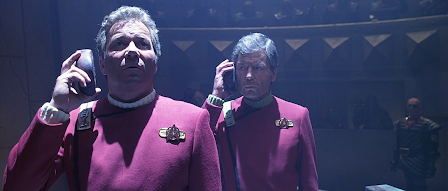
Framed for the murder of a Klingon ambassador suing for peace with the United Federation of Planets, Kirk and crew find themselves seconds away from a suicidal confrontation with a glowering battle cruiser. Rather than raise their shields and indirectly submit to the idea that any attack originating from the Enterprise was a deliberate act of provocation, Kirk immediately surrenders and beams aboard the Klingon vessel, with DeForest Kelley's Dr McCoy, to attend to the wounded. Undiscovered Country's weakness then is that it never makes this incredible leap of leadership a crux for anything other than further hardship for the human side of the cast. We are given no insight into how individual, Federation sympathetic, Klingons perceive this obvious behavioural contradiction. Any private thoughts or feelings they may have are kept buttoned up. Previous Star Trek films have positioned Kirk as a figure of respect within Klingon culture; they seem to view him as a particularly deadly human warlord. Surely his honest attempts at de-escalation should inspire an obvious level of pause in the Klingon high command?
Instead, Meyer's film concerns itself with rattling through a fragmented scheme that makes precious little sense even when all the pieces are revealed. For instance, if the phaser blasting assassins that murdered David Warner's Gorkon did originate from the Enterprise, why is their teleporter after-image red? Isn't that colour-coding usually associated with transportees originating from Klingon craft? It isn't commented on within the film so, presumably, this aesthetic decision was intended to signal something to the audience. A bread crumb to hint towards an as-yet-revealed invisible Bird of Prey stalking the Enterprise? Similarly, Kim Cattrall's Valeris, a treacherous element aboard the Starfleet vessel, is never organically threaded into the unfolding mystery. She's an observer then, suddenly, a solution. What Valeris does consistently provide though is an askew angle when appraising the strange sexuality of Leonard Nimoy's Spock. Their earliest scenes together feature an unusually relaxed Spock preparing drinks for the pair, lit by candlelight - alien ceremony with a hint of lumpen seduction. When Valeris' duplicity becomes clear, Spock's reaction is actually alarming. He strides over to his protégée - the frame itself rocking in time with his steps - then forcibly establishes a telepathic connection, one invasive enough that Valeris bares her teeth like an animal, tears streaming down her face.
Subscribe to:
Posts (Atom)