Showing posts with label Leonard Nimoy. Show all posts

Wednesday, 6 April 2022

Star Trek: The Motion Picture - The Director's Edition


Originally put together for an early 2000s DVD release by restoration supervisor Mike Matessino, producer David Fein and visual effects supervisor Daren Dochterman, Robert Wise's Director's Edition of Star Trek: The Motion Picture has drifted in limbo for the intervening decades - missing out on an entire generation of home video - thanks to a lack of forward-thinking when rendering the extended version's additional special effects shots. Specced (or more likely budgeted) for television broadcast and standard definition discs, the film's longer version was lumbered with an interlaced master; its elements lacking the kind of pixel bandwidth necessary to extract a high-definition alternative. Wise's preferred edit is only now available in 4K thanks to an unusually diligent restoration project that has, lovingly, reconfigured a film so time poor in terms of its original post-production that it was delivered wet to its premiere screenings. 

While it's difficult to not be sceptical about an expanded cut that arrives 17 years after the helmer's passing, Star Trek: The Motion Picture - The Director's Edition - although superficially similar to the 1997 Star Wars Special Editions - betrays little of the obnoxious third-party tinkering that George Lucas subjected his space opera series to. As with the previous DVD edit, The Motion Picture now opens with a Jerry Goldsmith overture, priming its audience for the more sedentary rhythms associated with Biblical epics. Extra moments and character clarifications are peppered throughout the piece, the best of which arrive in the third act: Leonard Nimoy's Spock expressing a kinship with the terminally unhappy machine they're investigating or James Doohan's Scotty patiently explaining that - on Kirk's orders - the ship's engine are being primed for self-destruct, a wrinkle that adds an extra layer of tension to the meeting with V'Ger. 

Obviously though, given how far removed from the original production this director's cut is, the majority of the attention the film receives is presentation based. Colour is corrected from the pallid countenance of the theatrical presentation to a more healthy hue while the film's soundtrack has been re-arranged to benefit Dolby Atmos equipment. This spatial audio allows the bleeps and blops of the Enterprise consoles to take on an almost symphonic quality that, at times, envelops the increasingly stunned crew. The photographical imperfections present in many special effects shots, thankfully, remain charmingly obvious and unchanged in this 2022 cut while the brand new CG shots, although not completely imperceptible, are often conceptually closer to the kind of work that Rafael Segnini is producing for his Kyojuu Tokusou Juspion web-series. It's an approach that sees computer effects used specifically to imitate the magical heft of miniature or puppetry special effects, rather than the physics-based sims modern movie goers have been trained to appreciate. A shot of the Enterprise docking with the living machine that sits at the centre of the V'Ger dreadnought is therefore designed to simulate two scale models knitting together in a cavernous studio setting rather than a more realistic collision between two massive interstellar objects. 
Monday, 14 February 2022

Star Trek VI: The Undiscovered Country


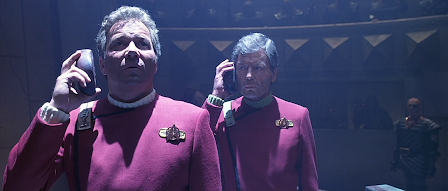
Nicholas Meyer's previous crack at Gene Roddenberry's science fiction series - Star Trek II: The Wrath of Khan - introduced the idea of Starfleet cadets being trained, on enormous holodecks, to navigate a no-win scenario as a way of testing how they might react under incredible pressure. In that film, Kirstie Alley's Vulcan prodigy Saavik voices her frustration at being forced into a situation where, apparently, there is no correct answer. Later on in Wrath we discover that William Shatner's Captain Kirk had previously beaten this Kobayashi Maru simulation, doing so after reprogramming the game's parameters to allow this victory. Although Star Trek VI: The Undiscovered Country revolves around the gradual decoding of a convoluted (and not particularly entertaining) conspiracy, Meyer's film - co-written with Denny Martin Flinn - does offer its audience a first-hand glimpse of Kirk defeating a similarly intractable problem.  

Framed for the murder of a Klingon ambassador suing for peace with the United Federation of Planets, Kirk and crew find themselves seconds away from a suicidal confrontation with a glowering battle cruiser. Rather than raise their shields and indirectly submit to the idea that any attack originating from the Enterprise was a deliberate act of provocation, Kirk immediately surrenders and beams aboard the Klingon vessel, with DeForest Kelley's Dr McCoy, to attend to the wounded. Undiscovered Country's weakness then is that it never makes this incredible leap of leadership a crux for anything other than further hardship for the human side of the cast. We are given no insight into how individual, Federation sympathetic, Klingons perceive this obvious behavioural contradiction. Any private thoughts or feelings they may have are kept buttoned up. Previous Star Trek films have positioned Kirk as a figure of respect within Klingon culture; they seem to view him as a particularly deadly human warlord. Surely his honest attempts at de-escalation should inspire an obvious level of pause in the Klingon high command? 

Instead, Meyer's film concerns itself with rattling through a fragmented scheme that makes precious little sense even when all the pieces are revealed. For instance, if the phaser blasting assassins that murdered David Warner's Gorkon did originate from the Enterprise, why is their teleporter after-image red? Isn't that colour-coding usually associated with transportees originating from Klingon craft? It isn't commented on within the film so, presumably, this aesthetic decision was intended to signal something to the audience. A bread crumb to hint towards an as-yet-revealed invisible Bird of Prey stalking the Enterprise? Similarly, Kim Cattrall's Valeris, a treacherous element aboard the Starfleet vessel, is never organically threaded into the unfolding mystery. She's an observer then, suddenly, a solution. What Valeris does consistently provide though is an askew angle when appraising the strange sexuality of Leonard Nimoy's Spock. Their earliest scenes together feature an unusually relaxed Spock preparing drinks for the pair, lit by candlelight - alien ceremony with a hint of lumpen seduction. When Valeris' duplicity becomes clear, Spock's reaction is actually alarming. He strides over to his protégée - the frame itself rocking in time with his steps - then forcibly establishes a telepathic connection, one invasive enough that Valeris bares her teeth like an animal, tears streaming down her face. 

Sunday, 6 February 2022

Star Trek V: The Final Frontier


Star Trek V: The Final Frontier suffers, in the main, from fielding concepts and ideas far grander than either first-time director William Shatner or his shortened production cycle is capable of completely tidying away. Despite a larger budget than the previous instalment - Leonard Nimoy's Star Trek IV: The Voyage Home coming in at an estimated $26 million to this film's $33 million - Final Frontier struggles to make the most of these increased funds. So, the world conquering mujahideen led by Laurence Luckinbill's Vulcan prophet Sybock amounts to little more than a dozen or so knackered looking extras while the Enterprise sets themselves visibly strain around our ageing actors. Shatner's onscreen bullheadedness - the actor cranking out Kirk at full volume here - is abetted by Andrew Laszlo's more obviously mobile photography style. The cinematographer brings a Steadicam glide to Star Trek, one that constantly pokes away at an unappreciative cast. Leonard Nimoy, in particular, looks exhausted throughout. The actor retreating into quiet murmurs when essaying this Spock.  

That is not to say Final Frontier is as awful as its Golden Raspberry award-winning reputation would suggest. On occasion the mismanaged money actually ends up working for the piece. A finale meeting with a malevolent alien posing as an Abrahamic God cannot afford the scripted host of rioting rock monsters, so the film settles for the wonderfully ludicrous sight of a disembodied energy head dragging its jaw through purple sands, chasing Kirk up the kind of rock formation familiar to anyone who watched the original Star Trek television series. Sybock isn't simply an alien madman either. Unlike the small screen televangelists that quite apparently inspired the character, this Vulcan emir does genuinely seem to believe that he's on a righteous quest to enlighten the galaxy. His methods though are alarming and deliberately overwhelming. Sybock uses his mastery of the mind meld to conjure up all-consuming vignettes that trap prospective disciples inside their worst moments as a way to then leverage a certain amount of control over that person. It's a beautifully blunt excoriation of any organised religion that uses human suffering as a bargaining chip. Spock and Kirk's reaction to these attempts at recruitment are even better again. Spock shrugs off a scene in which his father refuses to hold him as a newborn baby; Kirk doesn't even entertain Sybock's proposition, refusing to open himself up to examination then shrieking that he needs his pain and refuses to let go of it. 

Friday, 21 January 2022

Star Trek IV: The Voyage Home


Director Leonard Nimoy follows up Star Trek III: The Search for Spock with Star Trek IV: The Voyage Home, a light-hearted sequel that sees Kirk and pals using a captured Klingon warship to sling themselves around the curve of the sun, a feat that - thanks to Spock's cigarette packet calculations - hurls them back in time to San Francisco in the mid-1980s. Their mission in The Golden City? To kidnap a pair of humpback whales in the hope that these time displaced sea creatures can then communicate with the cigar-shaped interstellar object currently transforming 23rd century Earth into a boiling cauldron. Voyage Home is the time travel film told with the language of a culture clash comedy; incredulous Russian ensigns standing in for smiling Paul Hogan. Once touched down, the Enterprise crew make little to no attempt to fit in, remaining in their futuristic clothes and doing zero research about the time period they find themselves in. 

Voyage Home, like Ron Howard's Cocoon, is essentially a feature length opportunity for a gang of ageing stars to mix it up with reckless, grey-haired, abandon. Actors who - at this stage in their career - might otherwise be locked into one-note, supporting, roles are given the opportunity to be charming, even irreverent here. While Nimoy's film spends a significant amount of time basking in the chemistry generated by the actor-director and William Shatner's self-proclaimed expert, the rest of the crew do (finally) get their own mini-moments to shine. James Doohan's Scotty hams it up away from his teleporter console, posing as a Scottish Professor happy to trade fantastical chemical compounds with greedy line managers in a bid to secure the specialist water tank equipment their mission so desperately needs. There's a note of joyous vandalism in Scotty's subplot, the chief engineer belligerently dismissive of, and completely unconcerned with, any potential ramifications following his casual correction of history. Voyage Home is funny like that. 

Monday, 20 December 2021

Star Trek III: The Search for Spock


A sad, supplementary, sequel to Star Trek II: The Wrath of Khan that picks up in that film's dying moments then immediately sets about undoing its conclusion. In fairness to Star Trek III: The Search for Spock, its predecessor had already worked unusually hard to ensure that viewers were not left feeling that Spock's death was to be a permanent diversion for the series. Not only did Leonard Nimoy's Science Officer put a mysterious mind-zap on an unconscious colleague - key here to the Vulcan's eventual resurrection - but his torpedo chassis-cum-coffin was blasted at the Genesis planet, a cauldron of rebirth born out of an interstellar explosion in a swirling nebula. Search for Spock quickly undermines this potential for an ongoing, artificial, utopia by explaining that one of the project's key scientists, and Kirk's estranged son, cut corners. This attempt to brute force a new beginning has resulted in a planet that has already begun to shake itself apart. 

Although consistent in terms of the endemic arrogance displayed by the Kirk boys, it's a shame there's no attempt to contextualise this fracturing, apparently aggressive, world in terms of Khan's volcanic tempers - Genesis is, after all, a massive rearrangement of the super soldier's genetic material. Either way, this impending cataclysm gives the Enterprise crew a ticking clock; one that forces them to work against orders issued by an unconcerned Starfleet. If the Enterprise crew don't get to Genesis soon, Spock's eternal soul will be lost to the void. Directed by Leonard Nimoy, Search for Spock gets something out of William Shatner that no previous Star Trek feature has managed. His volume is turned right down, to the point where the often truculent actor actually registers as natural, even charming. Although his arc ends up being incurious and underwritten, we are (briefly) allowed to see Kirk experience real pits of despair during this journey. Elsewhere, Nimoy is shaky when it comes to action - the director very clearly having no taste for bloodletting - but happy to turn his frame over to massive, matte painted, vistas that throb with a period allure. 

Sunday, 19 December 2021

Star Trek II: The Wrath of Khan


Star Trek II: The Wrath of Khan represents a complete rethink of Gene Roddenberry's television series as a big screen property. A course correction even. Nicholas Meyer's film junks the celestial wonder of the financially unsuccessful Star Trek: The Motion Picture to focus on a smaller scale story, one ruled by heated human emotions rather than budget munching miniatures. Frequency and intensity of special effects aside, Wrath of Khan's most obvious and consistent points of departure from its predecessor are the ways in which this future is depicted. Motion Picture offered up an atypically fleshy intergalactic utopia - extras and the main cast both dressed in form-fitting slips that seemed to be reaching for a classical, Roman, immodesty. In practice, the wardrobe department delivered something closer to the lusty permissiveness of a Californian health farm. Wrath of Khan is gussied up by comparison, the Enterprise crew kitted out in ceremonial naval suits with Napoleonic overtones. 

Wrath of Khan then is a high seas adventure; a hermetically sealed submarine film played out against the backdrop of a massive purple nebula. Its climactic action sequence features two blinded, crumbling, craft rooting around in the ocean of space, both Captains attempting to gaze through static screens to get a bead on their quarry. When the Enterprise and Khan's hijacked Starfleet ship do clash they pull up alongside each other, emptying their photon cannons at exposed flank and battering their opponent's vulnerable, human, crew. Khan, played by Ricardo Montalban, thrashes around in a Shakespearean mania throughout; a raging storm of blood and invective, surrounded by muted, beardless, chattel. As wonderful as Montalban is - last seen chanting himself through ruinous head injuries with Herman Melville quotations - it's the dignity and quiet heroism of Leonard Nimoy's Spock that proves indelible. Braving a localised nuclear disaster to save his crewmates, a blistering and irradiated Spock uses his final moments to reassure William's Shatner's cocksure Captain that, despite appearances, he has acted logically - trading his own life for those of his friends.  

Friday, 17 December 2021

Star Trek: The Motion Picture


Standing in stark opposition to the briskly paced action adventure of its box office contemporaries - see Star Wars - Robert Wise's Star Trek: The Motion Picture is structured more like a seafaring voyage; a methodical pilgrimage into space to meet a machine God on a collision course with Earth. This digital deity seemingly intent on swallowing the planet whole. Wise's film is unhurried, a special effects piece completely infatuated with the miniatures mocked up by Douglas Trumbull and his team to represent warp speed craft and thundering technological landscapes alike. The camera pores over these scratch built mechanisms, demanding viewers slowly sink into the film. Verisimilitude achieved by asking the audience to consider these futuristic wonders in topographical, rather than toyetic, terms. The sequence used to introduce a docked Enterprise is long then but not laborious. William Shatner's Kirk and James Doohan's Scotty travel around the starship, both clearly awed. 

The Enterprise is photographed in segments, the film cutting back and forth between fresh glimpses of hulls or engines and two older men basking in a silent, collective, delight. While the characters gawp, the camera - their viewpoint - appraises the ship as if it is the most enormous, beautiful body they have ever seen. V'Ger, the undulating plasma cloud that frustrates Kirk and crew, is shot with a similar affection but its form is less inviting: a mix of aortic leaflets rendered in contracting metal and radiant, alloy cathedrals. Genuinely foreboding, at least at the outset, Star Trek: The Motion Picture consistently returns to an idea of impartial machinery attempting to assess or decode the human body in a similar fashion to Kirk's appreciative drive-by. An early teleporter malfunction, that results in a barely introduced Vulcan being reduced (offscreen) to screaming blubber, is the first such instance. It's an incident that neatly introduces the idea that when a dispassionate intelligence attempts to communicate with a species it views as vermin, we might then expect to see fragile bodies twisted into wreckage.