
Thursday, 16 June 2022

The Northman

When The Northman begins, Amleth - the Viking Prince who will soon consign his life to the pursuit of vengeance - is still a boy. His father, Ethan Hawke's stout King Aurvandill War-Raven, returns from conflicts abroad with a seeping injury, one that seems likely to expediate the guileless prince's path to the throne. When considering his child War-Raven lasers in on Amleth's innocence; he senses something pure and uncorrupted in this cossetted, wide-eyed adolescent. Traits, incidentally, that this King feels are incompatible with the brutal monarchy that War-Raven has upheld. Despite protestations from Nicole Kidman's Queen, the father and his son partake in a ceremony designed to hasten Amleth's creep into adulthood. It's a shamanic ritual, resided over by Willem Dafoe's court fool, in which the two royals strip naked, bray and fart like animals, then drink mead spiked with a hallucinogenic. This witchery allows the pair to grasp at ethereal, reality-defying, visions that position their family within a massive tree root that extends off into distant futures.
Immediately following this psychedelic service, War-Raven is set upon and killed. Amleth escapes but never recovers from this outrage. His identity and outlook are frozen in the moments that he watched, helpless, as his father was murdered and his mother was carried away as plunder. Amleth therefore never quite shakes off the spell that was cast over him in that smoke-choked hut. The animal aspect that was summoned is never corrected by a return to the patterns and rhythms of a courtly life. The oath he swears during his escape - to avenge his father and free his mother - becomes an all-consuming ideological fulcrum. A desire for correction now burns within Amleth. The emotion has swallowed him whole, feeding the slathering, amoral might that lurks within. It's obvious then that The Northman owes John Milius and Oliver Stone's Conan the Barbarian a massive structural debt. Writer-director Robert Eggers and co-writer Sigurjón Birgir Sigurðsson treat that 1982 sword and sorcery film as a blueprint, battering a Scandinavian legend until it pivots on similar beats. Flourishes and embellishments are applied to Milius' sacred text: so while Conan steals a bastard sword away from a trembling Atlantean mummy, in Amleth's tale the corpse actually rises, joining battle with its graverobber.
The years between Amleth's flight and an opportunity to enact his revenge are a blur of frenzied violence. The prince - now played by a strapping Alexander Skarsgård - is a mercenary working with a clan of Viking berserkers. Pointedly, Amleth is party to, but not directly involved in, a kind of casual atrocity that undermines the conceptual purity of his own personal quest. His band generates enmity on a tremendous scale, tearing children and babies away from their screaming mothers then burning them alive. Skarsgård communicates a sheepishness in these scenes; an understanding that he is a component in a machine that perpetuates the kind of misery that drives his own vendetta. Later when Amleth has lied his way into a position that allows a chance at retribution, real-life circumstances gnaw away at his fantasy. The Wagnerian torment he has given his life over to is repeatedly undermined. First by the diminished circumstances he finds his treacherous uncle in, later by the poison that drips from his own mother's mouth. Eggers and Sigurðsson never let us forget that, in his heart, Amleth is a thwarted child. Jealousy prickles when he sees his mother loving another son and he willingly suffers through months of slavery just to decode a familial affection that he himself has never experienced. The final act of The Northman sees Amleth sinking deeper and deeper into delusion as a response to the devastating truths that assault him. The form of the film twists and turns in sympathy, rejecting muddy historical reality in favour of supernatural reverie.
Saturday, 11 June 2022
Friday, 10 June 2022
Street Fighter 6 - HANDCUFFS
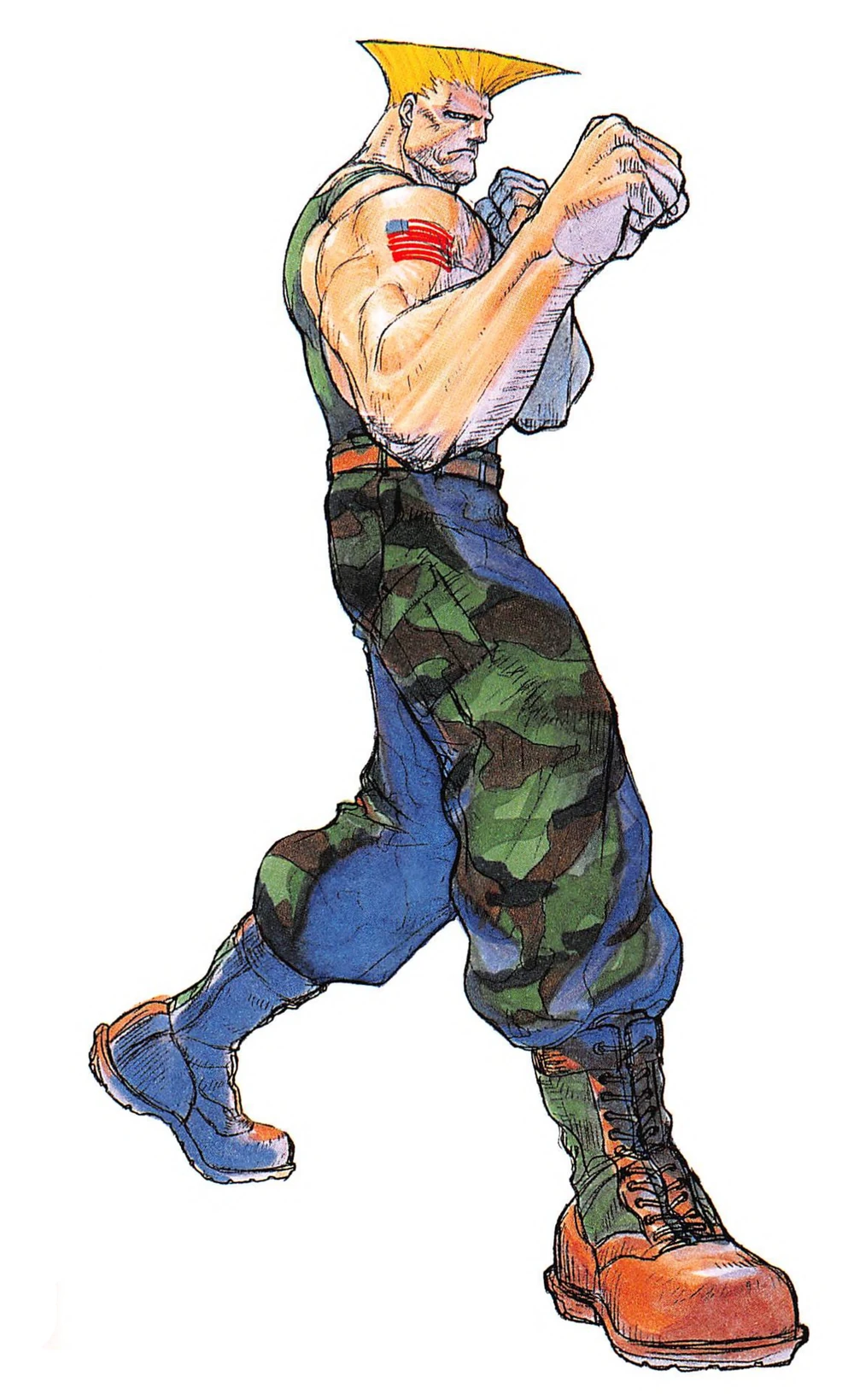
In terms of instantly recognisable video game characters, Street Fighter II's World Warriors take some beating. Each one of the original eight globe-trotters were so perfectly composed that even the lightest remix (Hyper Fighting's colour swaps excepted) borders on pointless. Not that Capcom is happy to rest on their laurels. The company can't help burying their cast under affectations that players then can't wait to reverse, necessitating a trip to the app's online shop to pick up a classic costume. For instance, did Akuma really need a lion's mane in Street Fighter V? Similarly, after hitting on that cracking undead Ryu design in Super Street Fighter IV: Arcade Edition, was V's killing intent variant in desperate need of a pair of neon pink devil horns? So what wilful sabotage have Capcom cooked up for their sixth instalment? Aside from a Ryu that (in fairness) looks genuinely fantastic we have a Guile with the jawline and blonde facial hair of WWE's resident belt hoarder Brock Lesnar. Not awful then, but still not a patch on a Super X-era Daigo Ikeno pin-up.
Final Fight Ultimate - BLASTED
First look at a Final Fight fan project that shrinks Capcom's seminal coin-up down to Mega Drive dimensions. Although there's not much but menus in this clip, Edmo Caldas, Master Linkuei and Mauro Xavier's Final Fight Ultimate already looks about on par with the nearest equivalent adaptation, the 1989 Mega CD release, and conclusively trumps the period SNES cart(s) by allowing players to chose from all three street fighting characters. Although hardly a fair match-up, given the intervening decades of accumulated compiling know-how, it's still fun to see Sega's humble 16-bit system pushed to its limit.

Thursday, 19 May 2022
Wednesday, 18 May 2022

The Abyss - Special Edition

The Abyss is a cacophony of drips. Anxiety rolls off the film in waves; the viewer made to feel the cold, pruning ache that comes with occupying a leaky metal box that has been sunken into the pit of the ocean. Tasked with providing a base of operations for Michael Biehn's jittery SEAL rescue team when an American nuclear submarine goes bottom up, Ed Harris' Bud Brigman, and the crew of the Deep Core experimental drill platform, suffer their way through a steady stream of escalating dangers. The personal hell of having to share a collapsing space with an inflexible ex-wife he's still very much in love with - Mary Elizabeth Mastrantonio's Dr Lindsey Brigman - turns out to be a minor discomfort for Bud when compared to the litany of hazards that await them all beneath the waves. A flooded, Ohio-class tomb gives way to a series of close encounters compounded by swirling topside storms, a spiralling international crisis, and a dead-eyed psychopath who has taken possession of a Trident warhead.
Rather than contrive a film's worth of interjecting hazards, writer-director James Cameron wrings drama out of his established milieu: bad oxygen tank mixes cause comas for minor players in the early going, while bulkheads buckle and burst when placed under incredible pressures as we plummet into the second act. These disasters don't present as contrivance either, they are a checklist of worst-case scenarios. The nightmare thoughts that have, quite obviously, crept in while Cameron was himself living through his own, practical research. Every calamity feels strangely inevitable then, the logical outcome of the film's obstinately perilous circumstances. Even Biehn's Lt Coffey, although happy to follow whatever apocalyptic orders are beamed down to him from his bloodthirsty superiors, explicitly suffers through a neurological episode caused by the intense physical strain of diving, then maintaining, the human body at so deep a depth. Typically a sensitive, even romantic proposition in Cameron's other films, this Biehn performance exists at the other end of the emotional scale. Coffey is tremulous and chlorine-stained; a highly strung soldier attempting to power through a failing physical and mental state by repeatedly drawing a boot knife across his own forearm.
As great as Biehn is, the film belongs to Harris and Mastrantonio. The hysteria their later scenes generate is so strong - so violently and nakedly distressing - that they actually end up unbalancing the film, vanquishing CG sequences that explicitly entertain the total destruction of mankind. This being a James Cameron film, The Abyss does not have just one finale. Firstly, we have a tense submarine (!) chase that resolves with the estranged Brigmans trapped in a flooded, sparking, submersible. Then a dilemma: with one oxygen mask and tank between them, the decision is made - by Lindsey - to allow herself to drown while Bud tows her body back to the remains of the Deep Core. Harris screams and slaps his way through a seemingly hopeless resuscitation sequence, the actor appearing to purge himself of the nervous breakdown-level exasperations associated with shooting a special effects film while genuinely submerged in stinging water. Everything that follows Lindsey's resurrection feels like a winding, superfluous comedown by comparison. The scale of potential destruction may have increased massively - as well as having a sunken nuclear warhead in play, this Special extended Edition ratchets up the Cold War tensions and introduces the threat of multiple mile-high tidal waves - but the claustrophobic terror we intruded upon earlier has been settled and, to a degree, dispelled. Lindsey and Bud have already reconciled.
Monday, 16 May 2022
Wednesday, 11 May 2022

The Sadness

What The Sadness lacks in plot it more than makes up for in pulsing viscera. Set in pandemic era Taiwan, writer-director Rob Jabbaz's film stalks the well-trodden path of two disentangled lovers fighting their way back to each other while the world falls apart. Berant Zhu's Jim and Regina Lei's Katie are the young co-habiting couple who find themselves at the opposite ends of Taipei when a highly contagious sniffle suddenly mutates into the catalyst for ultraviolent mayhem. The Sadness differentiates itself from the rest of the endlessly shuffling pack by shifting the undead's focus from pure calories to a kind of consumption that views other people in transactional or material terms. The goal then is for these zombies to make playthings of the uninfected: they tease and torture their prey, delighting in the horrifying power they hold over other people's bodies.
Neither Jim nor Katie is afforded any real depth in The Sadness. Jabbaz's film preferring to consider the actors and their characters in purely utilitarian terms - both are simply good-looking focal points for the incoming waves of terror. In fact, the role through which we receive the most insight into this bubbling frenzy is Tzu-Chiang Wang's ominous Businessman. Initially encountered as a pestering presence on a packed commuter train, Businessman's mumblings quickly transform from a lonely, inexpert, attempt to trap Katie in a conversation to a frothing, stated, desire to rape her. He never shuts up, verbalising and even acting out every terrible thought that flickers across his mind. This explicit threat of sexual violence is woven throughout Jabbaz's film, positioned as the direct result of diseased brains that are no longer able to filter or thwart their invasive thoughts. The Sadness is a despairing film then, one in which the male example of the human animal is firmly, and repeatedly, contextualised in hopelessly predatory terms.
Friday, 6 May 2022
Subscribe to:
Posts (Atom)