Wednesday, 6 April 2022

Star Trek: The Motion Picture - The Director's Edition


Originally put together for an early 2000s DVD release by restoration supervisor Mike Matessino, producer David Fein and visual effects supervisor Daren Dochterman, Robert Wise's Director's Edition of Star Trek: The Motion Picture has drifted in limbo for the intervening decades - missing out on an entire generation of home video - thanks to a lack of forward-thinking when rendering the extended version's additional special effects shots. Specced (or more likely budgeted) for television broadcast and standard definition discs, the film's longer version was lumbered with an interlaced master; its elements lacking the kind of pixel bandwidth necessary to extract a high-definition alternative. Wise's preferred edit is only now available in 4K thanks to an unusually diligent restoration project that has, lovingly, reconfigured a film so time poor in terms of its original post-production that it was delivered wet to its premiere screenings. 

While it's difficult to not be sceptical about an expanded cut that arrives 17 years after the helmer's passing, Star Trek: The Motion Picture - The Director's Edition - although superficially similar to the 1997 Star Wars Special Editions - betrays little of the obnoxious third-party tinkering that George Lucas subjected his space opera series to. As with the previous DVD edit, The Motion Picture now opens with a Jerry Goldsmith overture, priming its audience for the more sedentary rhythms associated with Biblical epics. Extra moments and character clarifications are peppered throughout the piece, the best of which arrive in the third act: Leonard Nimoy's Spock expressing a kinship with the terminally unhappy machine they're investigating or James Doohan's Scotty patiently explaining that - on Kirk's orders - the ship's engine are being primed for self-destruct, a wrinkle that adds an extra layer of tension to the meeting with V'Ger. 

Obviously though, given how far removed from the original production this director's cut is, the majority of the attention the film receives is presentation based. Colour is corrected from the pallid countenance of the theatrical presentation to a more healthy hue while the film's soundtrack has been re-arranged to benefit Dolby Atmos equipment. This spatial audio allows the bleeps and blops of the Enterprise consoles to take on an almost symphonic quality that, at times, envelops the increasingly stunned crew. The photographical imperfections present in many special effects shots, thankfully, remain charmingly obvious and unchanged in this 2022 cut while the brand new CG shots, although not completely imperceptible, are often conceptually closer to the kind of work that Rafael Segnini is producing for his Kyojuu Tokusou Juspion web-series. It's an approach that sees computer effects used specifically to imitate the magical heft of miniature or puppetry special effects, rather than the physics-based sims modern movie goers have been trained to appreciate. A shot of the Enterprise docking with the living machine that sits at the centre of the V'Ger dreadnought is therefore designed to simulate two scale models knitting together in a cavernous studio setting rather than a more realistic collision between two massive interstellar objects. 

Jerry Goldsmith - Overture

Kavinsky - Cameo (feat. Kareen Lomax)

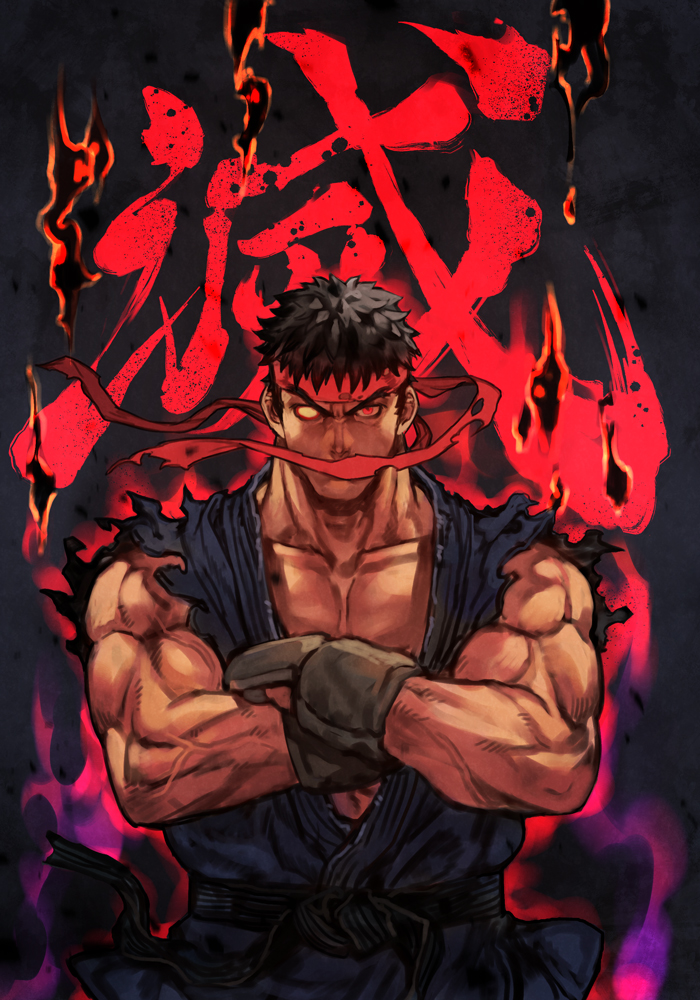
Evil Ryu by Hungry Clicker

Tuesday, 22 March 2022

Spider-Man: No Way Home


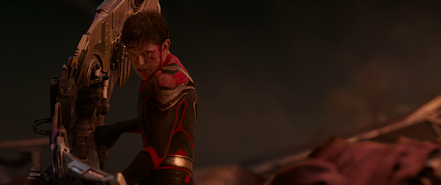
Heavily indebted to Bob Persichetti, Peter Ramsey and Rodney Rothman's excellent Spider-Man: Into the Spider-Verse, Jon Watt's multi-dimensional pile-up, Spider-Man: No Way Home, employs the same reality-bending as its animated predecessor - not to mention the current Marvel streaming shows - to give this increasingly disconnected sub-series (as well as long-time executive producer Avi Arad) a victory lap. In doing so, No Way Home batters Tom Holland's likeable take on Peter Parker out of his moneyed comfort zone to re-establish a balancing act minted in a previous Spidey phase. The film abandons the overloaded technological wish-fulfilment - that saw Spider-Man subordinated into the role of Iron Man's teenage ward - to push at the working class ache that underpinned Sam Raimi's take on the character. No Way Home drags in adversaries from these Raimi films, as well as the two Marc Webb instalments that followed, as a way to brute force Holland's Parker through this conceptual shake-up. 

No Way Home is a piecemeal experience. Strange highlights - imported from different films and deployed to wrinkle recognition - struggle to exert themselves on a whole that seems to be either thrashing around in the midst of an onscreen identity crisis or simply holding the Spider-Man character to ransom ahead of the next round of financier negotiations. Willem Dafoe's Green Goblin is an obvious but under-explored delight though. The character's trajectory built around the tensions of a personality split that, unfortunately, we barely see overlap. Still, even if No Way Home doesn't apportion enough screentime to Osborn to manufacture a believable (or even trackable) sense of mounting disquiet, the film does remember that the action in the first Spider-Man's was defined by a deeply personal strain of violence. While the weight that Watts and his screenwriters (Chris McKenna and Erik Sommers) heap on their hero never comes close to matching the face-swelling welts that Raimi dished out, Holland does get to play murderous rage: punch after punch, hammering down on the teeth of a clearly ecstatic Goblin. For a series of films in which (comfortably) billions of people have died, the motivational power of pure hatred is a note that has been largely absent. 

Hotel Pools - Vital

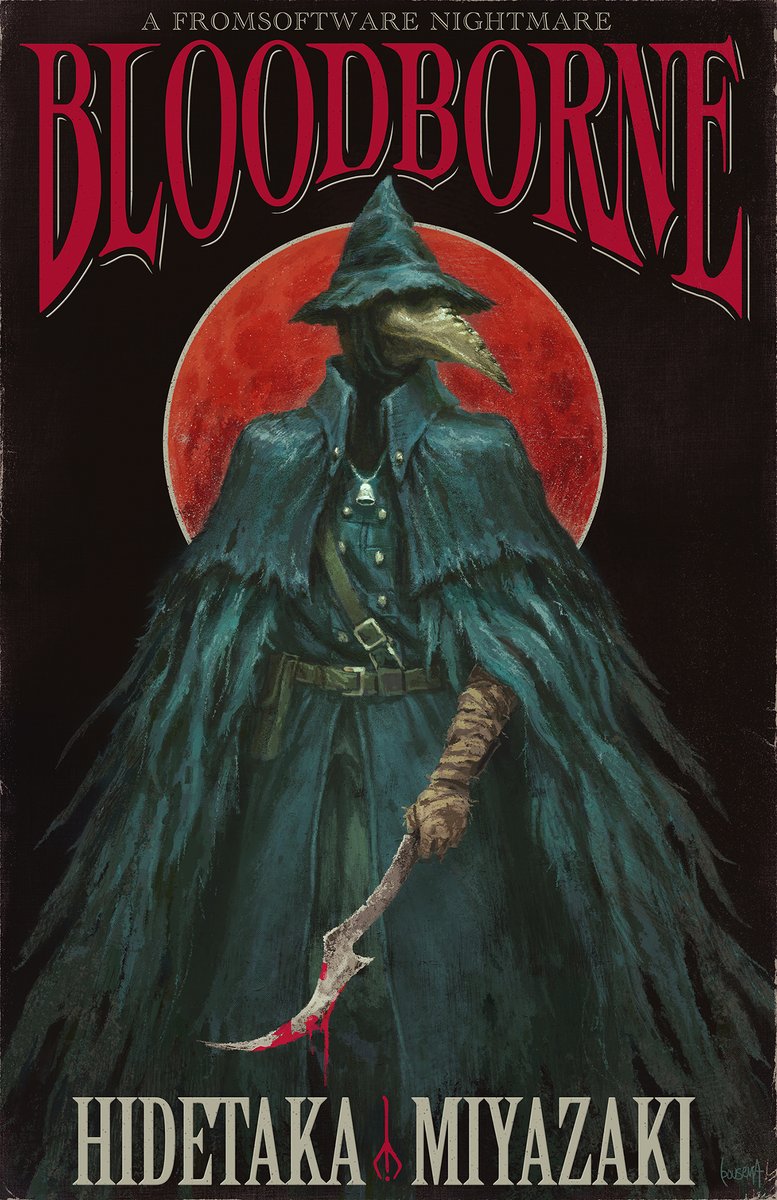
Weird, Weird Dog by Dood

Harry Nilsson - Without You

Wednesday, 16 March 2022

Gemini Drive - Remember

The Comics Journal - Fist of the North Star Volumes 1-4


Jumped at the chance to write about the first four volumes of Viz's recent Signature releases of Fist of the North Star for The Comics Journal. If you're not familiar with Buronson and Tetsuo Hara's series, expect muscular messiahs battling for supremacy in the ruins of the twentieth century. 

Wednesday, 2 March 2022

Texas Chainsaw Massacre


Pitched as a belated continuation of Tobe Hooper's The Texas Chain Saw Massacre, David Blue Garcia's Texas Chainsaw Massacre - itself the ninth entry in this petrol-powered series - betrays little understanding of the original masterpiece as anything other than a vehicle for a stylised ogre to murder young people. Legendary Pictures' approach then is similar to the increasingly disconnected Friday the 13th sequels; a vague idea of continuity that, in truth, has been boiled down to the recurring threat generated by looming musculature with an affinity for power tools. Garcia's film - screenplay credited to Chris Thomas Devlin with story credits going to Rodo Sayagues and producer Fede Álvarez - also finds a couple of spare minutes to lift the avenging final girl conceit underpinning the recent refresh of the Halloween franchise. Sally Hardesty, the only survivor of the 1974 incident, has bounced back from what looked like a lifelong catatonic episode to show up, mid-mulch, for an unsatisfying third-act fumble. 

Although no big shakes themselves, David Gordon Green's films do at least apportion a significant amount of their run-time to understanding the damage experienced by their heroines. Comparatively, this Massacre goes out of its way to snub Olwen Fouéré's take on Sally, reducing her to a clumsy emissary of the Remington Arms company. Largely contrived and mechanical in its execution, this Texas Chainsaw Massacre does manage a healthy thrum when we are allowed to see Leatherface rattling around in his private moments. One bystander, as they struggle to free themselves from a totalled police van, witnesses Bubba violently reclaiming the motherly mask intrinsically linked to his atrophied super-identity. Back in the home that has sheltered him in the intervening decades, a different victim watches as this killer attempts to process loss by staking a claim on his warden's clothing and make-up. These scenes are as close as Massacre number 9 gets to the trophy gathering predilections of Ed Gein, the necrophiliac body snatcher who served as inspiration for Hooper's nightmarish classic.