Showing posts with label Johannes Roberts. Show all posts

Monday, 13 April 2026

Primate


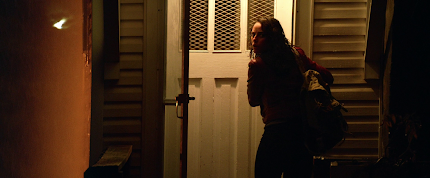
After years of pixel perfect reproductions of aggro chimpanzees, specifically in the recent Planet of the Apes phases, it's a pleasant surprise to be treated to a suit-acted Primate. Miguel Torres Umba plays Ben, a chimp living in glass house captivity with a family comprised of a deaf father named Adam, played by Troy Kotsur, and his daughters, Johnny Sequoyah's Lucy and Gia Hunter's Erin. Bitten by a rabid mongoose offscreen, Ben glowers and froths, eventually transforming into a bone-breaking monster. Obviously prompted by a similar simian attack in Jordan Peele's excellent Nope, director Johannes Roberts' Primate is a feature-length extrapolation shot digitally on London sound stages and cast in blazing reds and powdery cobalt that suggests a, presumably absent, temperature. Neither as tense or oppressive as the POV Nope interlude, where Primate does impress is how it suggests some level of thwarted agency or even interpersonal jealousy behind Ben's destructive acts. 

Rabies here is used as a way of unlocking a kind of interspecies bitterness that has simmered in a creature that lives amongst, but cannot truly connect with, people. Ben takes bites out of the thigh of his nearest contemporary, youngest daughter Erin, apparently a demonstration of possessive, consumptive intent. A frat boy love interest played by Charlie Mann, who appears much later in the film, is trapped than examined by Ben. His simpering white boy features pored over and collated, before Ben begins tugging aggressively on his jaw, obliterating his agreeable, human face. Primate is thinly written, with shallowly realised characters (the absolute limit of communal jeopardy is the forwardness with which Jessica Alexander's Hannah behaves around a friend's crush) but there is something unexpectedly sad about the performance generated by a man playing a simian who lashes out at his human owners because a viral infection has turbo-charged his grievances. His diminished, childlike stature, within a family that has already begun to grow apart, has become intolerable for this superhumanly powerful simulacrum. 

Monday, 3 January 2022

Resident Evil: Welcome to Raccoon City


With Paul WS Anderson and Milla Jovovich out of the picture, it falls to Johannes Roberts to reanimate the big screen ambitions of Capcom's hugely successful video game series. Resident Evil: Welcome to Raccoon City goes back to the original PlayStation games (or, rather, the recent remakes of those first few entries) to tell the story of a small town on the verge of collapse. Instead of a designer virus transmitted from a chemical weapons facility to a civilian population via infected wildlife though, writer-director Roberts locates Raccoon City firmly within the American poison belt. Portrayed in the console series as a warren of interconnected shops and bars - distinctly Japanese urban planning transplanted to Midwestern America - this Raccoon City is a predominantly working class Podunk that has been slowly and methodically contaminated over the course of decades. 

While Kaya Scodelario's Claire Redfield roots around a dingy suburban hovel in search of her brother, the mother and child next door loom in their rundown home, peering out of windows so we can note that their scalps have been picked clean. Across town, a truck stop waitress weeps blood and thinks nothing of it - spontaneous haemorrhaging apparently an everyday occurrence in this neighbourhood. When an enforced lockdown goes into effect, the town's police are subordinated then routed. Gas mask commandoes line the roads, executing the handful of citizens who have made it as far as the blockades. In its early passages Welcome to Raccoon City, a period piece set in the late 1990s, captures the rhythms of that era's straight-to-shelf action horror; specifically the micro-budget sequels destined for Blockbuster Video. 

Roberts and cinematographer Maxime Alexandre manufacture the look and feel of Dimension Films filler - from the pitch black sets broken up by gun mounted torches to a sulphurous, emergency exit approach to lighting. As Welcome rattles on towards its conclusion, this niche approach to entertainment completely breaks down into a rote, unexciting remix of its source material. Roberts' film leaps back-and-forth between the Spencer Mansion from the original Resident Evil and the equally labyrinthine police station from Resident Evil 2; events in either location failing to either congeal into an effective source of tension or trigger some unseen, and no doubt diabolical, mechanism. The insidious evil of a pharmaceutical corporation that keeps a paramilitary unit on its books gets away from Roberts as well, Welcome preferring to default to an aimless series of confrontations with crude, and obviously computer generated, creatures.