Showing posts with label Courteney Cox. Show all posts

Thursday, 26 March 2026

Scream 7


Hastily retooled and rewritten after production company Spyglass accused actress Melissa Barrera of being antisemitic for her pro-Palestinian social media posts, writer-director Kevin Williamson's Scream 7 (Williamson co-writing with Guy Busick) is, at least in terms of its structural identity, exactly as rushed and misbegotten as you might expect. The firing, not to mention slandering, of Barrera resulted in a collapse of this modern Scream phase: Jenna Ortega, citing commitments to Netflix's Wednesday, exited this sequel during the development phase and Happy Death Day director Christopher Landon (who was drafted to replace Scream and Scream VI directors Matt Bettinelli-Olpin and Tyler Gillett) walked, stating that the project he signed on to steward was no longer possible. Presumably, this speculative seventh Scream would have dealt with the increasingly frayed psyche of Barrera's schizoaffective Sam Carpenter. 

Williamson's Scream 7 then largely dispenses with the accrued baggage of latter-day Scream sequels to focus on Neve Campbell's Sidney Prescott, a character that had become something of an afterthought in these newer films. Sidney was reduced to little more than a cameo in the fifth Scream, chatting away with Courteney Cox's Gale Weathers at a safe remove, and completely absent from Scream VI, reportedly because Paramount Pictures were not interested in paying Campbell an amount that she felt comfortable with. All of which is to say that the mercenary, behind-the-scenes throat-cutting that underwrites this particular sequel is a lot more exciting than the film Williamson has served up. Despite writing the reasonably well received Peacock Original, and John Hyams directed, Sick - basically a pandemic-themed Scream spin-off - Williamson utterly fails to construct a satisfying or even diverting whodunnit here. 

When the killers are finally revealed, unfortunately the centrepiece moment in every episode of this franchise, there's no sense that several disparate details or dangling insinuations are, finally, locking into place. Instead we're faced with two underwritten nobodies suddenly promoted into positions that their previously minor screentimes cannot hope to support. So farcical, or even contemptuous, are these reveals that all interest in proceedings immediately evaporates. Although hardly a series highlight even before this grinding gear shift, Scream 7 does betray a certain conceptual continuity with earlier sequels, specifically a pair of kills that, like Scream 2, indicate some trace knowledge of violent, Italian thrillers. A fake-out involving Joel McHale, as Sydney's unconvincing beat cop husband, and wreaths of tarpaulin doesn't quite dispense with the geography of a suburban garage enough to truly sing but the murder of Mckenna Grace's Hannah, dressed as Tinkerbell and suspended in a harness she cannot unclip herself from, cannily combines the cruelty and inevitability of giallo in an era where such dismemberment frequently takes on absurdist or even darkly comedic notes. 

Monday, 1 May 2023

Scream VI


It seems churlish to criticise a Scream sequel for being so relentlessly self-referential. After all, the entire series is built out of its characters' acute awareness that the slasher movies they have experienced as viewers can now be used as ammunition against the costumed assailants trying to stab them. The frazzled lectures of each film's terminally aware film freak then function as pitch meetings: the fiction itself speaking to its audience about how they can expect events to be framed from that point on. They either lay out all the twists and turns, with an ironic inflection, or firmly establish a daunting step-by-step that will then be subverted. By Scream VI though, co-directed by Matt Bettinelli-Olpin and Tyler Gillett, this sustained commitment to metatextual reproduction has transformed into navel-gazing. Despite a New York setting, this is a strangely routine sequel. An instalment happy to churn, adoringly, through the sights and sounds of its own immediate predecessors rather than, say, the 1970s and 1980s horror films that defined the (by now long forgotten) tape rental era. So while Wes Craven's Scream 2 might have featured a sequence based around screenwriter Kevin Williamson's memories of Dario Argento's The Bird with the Crystal Plumage, Scream VI simply regurgitates the invincible supporting cast and university setting of its own ancient ancestor, Scream 2.

Thursday, 22 April 2021

Scream 3


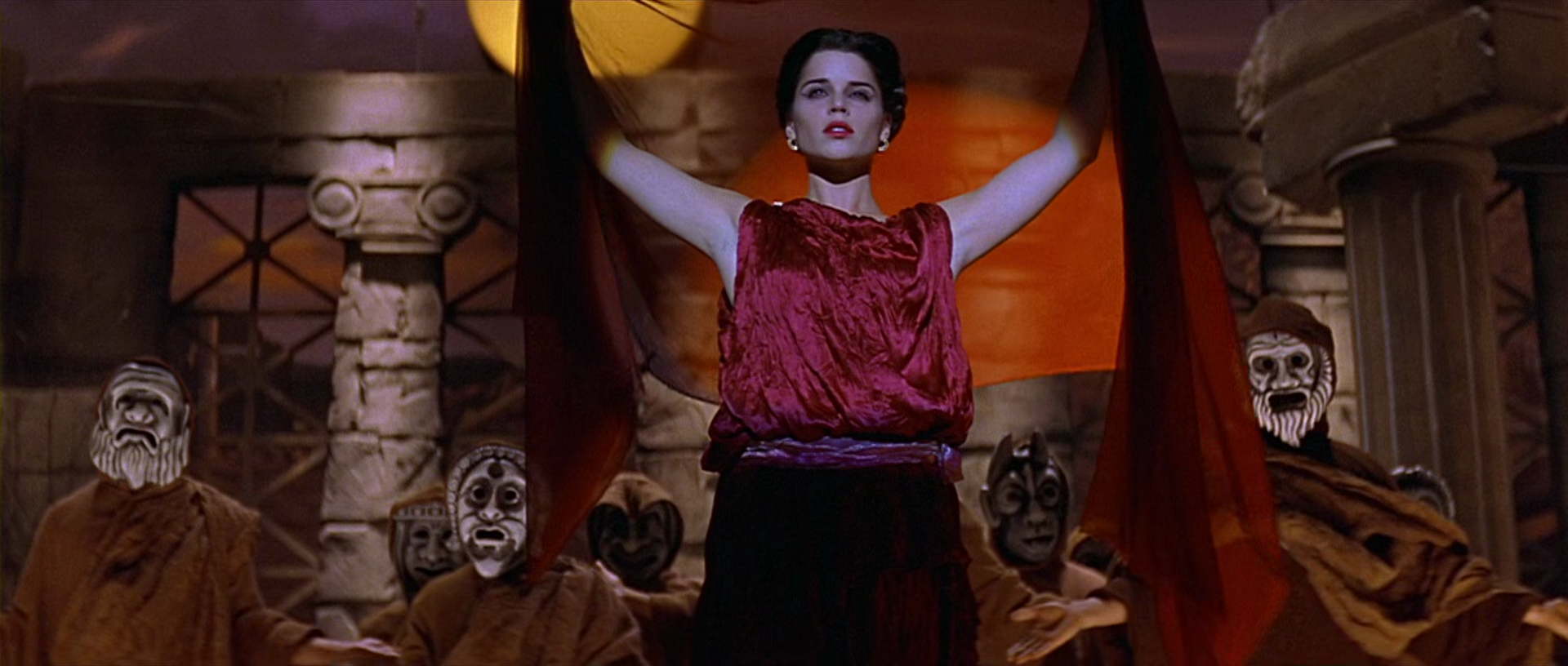
Firmly in the realm of Scooby-Doo, Where Are You! nonsense, Scream 3 sees the series slide further into a bloodless, but still entertaining, state of self-parody. Director Wes Craven's third entry, working from a script by Ehren Kruger (Transformers: Revenge of the Fallen, Dark of the Moon and Age of Extinction), allows the characters to drift a little further away from each other before it finds a homicidal cause to reunite them. Neve Campbell's Sidney Prescott lives in picturesque seclusion, fielding crisis calls from victims of domestic abuse. David Arquette's Deputy Dewey, now a little steadier on his feet, works in Los Angeles as a technical consultant on Stab, the schlocky horror franchise based on the events of this film series. Courteney Cox's indefatigable Gale Weathers is also out and about in Tinseltown, meeting the actress who portrays her on the silver screen - Parker Posey's hare-brained Jennifer Jolie - and investigating the secret Hollywood history of Sidney's dead mother, Maureen. 

Seemingly barred from exploring lacerating violence, this sequel leans closer to the strange and supernatural than any previous Scream. Sidney is visited in her dreams by her murdered parent, a restless, rotting spectre who smears her congealed blood all over her daughter's beautiful bay window. This film's Ghostface - essentially an abandoned child in the midst of violent hissy fit - appears then disappears with the teleporting logic of a Jason Voorhees. He is also, similarly, immune to small arms fire. This turbo-charged killer has access to a portable voice changer that allows him to sample and remix speech from any source, enabling all sorts of simulated betrayal. The show business setting, broad enough to encompass other damned citizens of the Weinstein cinematic universe, vacillates between the comedy observed in unacknowledged narcissism and, in its bleaker moments, hints at the yawning chasm within the powerful men who take full advantage of young, struggling actresses. In this sense Scream 3 does provide a thematic connection to the first film, but the crimes of these sexually abusive men are crowded out by a final act reveal that dares to rewrite established text. 

Thursday, 15 April 2021

Scream 2


Rushed into production after the success of the first film, Scream 2 is less concerned with following up on the themes and threads of its predecessor and more interested in examining itself from a metatextual perspective - the quicky sequel as an obligatory, and financially lucrative, imperative. Director Wes Craven and screenwriter Kevin Williamson both return, their second stab at the material seeking to deconstruct immediate follow-ups as a concept, specifically the ways in which successive instalments attempt to re-bottle lighting. In Scream 2's case, this is an especially difficult proposition. How can the filmmakers follow on from a film that was designed to present itself as literate, but ironic, and which concluded with both murderers definitively vanquished? Turns out branding is the series' most consistent aspect then - Scream 2's killers adopt the same ghostly fright mask persona as Stu and Billy Loomis. 

Although not necessarily ill-considered, there's a sense of needless haste in Scream 2. Particularly when it comes to the finesse side of the production. The first Scream had a strangely indifferent musical voice, crowbarring in Nick Cave & The Bad Seeds or grinding mood pieces to bluntly and instantly establish a scene's tone. Scream 2 goes even further into temp-tracking, licensing a Hans Zimmer piece from John Woo's smoky, swaggering Broken Arrow (released not even two years prior) that springs to life every time David Arquette's unwavering ex-cop Dewey does something gently masculine. The music isn't at odds with the image in this instance, in fact the unhurried plucking compliments them greatly, but you're always aware that these notes have been lifted from another, hardly obscure source. At the other end of the scale, the fetid approximation of Ska that closes the film does nothing but puncture a sadly listless Sidney's hard won sense of victory. This clumsiness extends out into Scream 2's structural make-up too: the détente between Neve Campbell's Sidney and Courteney Cox's muckraking reporter Gale Weathers dissolves so instantly that the falling out feels less like characters expressing personal betrayal and more like an artificial obstacle dumped carelessly into the film. 

While not as fun as a high school friendship circle in homicidal meltdown, Scream 2's university setting does allow a certain kind of young adult pantomime to emerge. These students dress and behave with an air of affected maturity; teenagers straining to live with a straight-laced professionalism they've only read about in lifestyle magazines. Disappointingly, this tension between commercial façade and disappointing reality doesn't feed into either of the killers' intentions or identity. The duo stalking Windsor College don't have a motive carefully threaded throughout the meat of the episode either, their causes aren't even aligned with each other. Timothy Olyphant's Mickey has a reheated copycat motive while Laurie Metcalf's Debbie Salt eventually drops her phoney reporter cover to behave with the shrieking mania of a slasher movie mother. A far more bombastic conclusion than Scream's idiots dying in slow motion then. While the film doesn't quite come together thematically, it does contain a couple of carefully crafted set-pieces, the best of which sees Sidney and her friend, Elise Neal's Hallie, crawling from the back seat of a crashed patrol car, past the remains of a burst policeman and over an unconscious costumed murderer. 

Monday, 12 April 2021

Scream


Remembered for a misleading ad campaign that seemed to position Drew Barrymore as the star or the ways in which Jamie Kennedy's video shop clerk directly addressed the audience, Wes Craven's Scream - at least on this viewing - plays more like a film committed to detailing a particularly awful relationship. Neve Campbell plays Sidney Prescott, a traumatised teenager mourning the brutal murder of her gossip magnet mother. Her boyfriend, Skeet Ulrich's Billy Loomis, quivers with hormonal tension, absolutely desperate to trap Sidney in any situation conductive to him taking her virginity. Knowing the film's twist - that boyfriend Billy and his lickspittle, Matthew Lillard's Stu, are the killers - reorganises Craven's slasher film, magnifying the kind of pleading and placating inherent to any relationship in which one party is doggedly seeking some kind of access from another. 

Billy is consistently thoughtless throughout Scream, acting with a creepiness that is only really massaged by the proximity Sidney allows this boy to have to her. Sidney holds a certain kind of status within the film, apart from being the main character she's portrayed as forthright, morally good, and willing to take physical action when prompted. The character therefore works against a designation of one-dimensional victim. This standing has a knock on effect for Billy: if the clever and collected Sidney sees something in him, maybe we should too? Really, Billy isn't too far away from the hornier male characters present in screenwriter Kevin Williamson's contemporaneous TV series Dawson's Creek. Billy is pop culture (rather than emotionally) literate and, seemingly, sensitive enough to play the long game with a girlfriend who isn't currently comfortable having sex with him. This young man needles though. Beginning with an impatient hectoring, his arguments grow steadily over the course of the film. 

Billy's need to get his own way eventually reveals a complete absence of empathy. The ghost-faced Father Death costume that conceals Loomis and Stu when they are out on the prowl is not only emblematic of the stark psychological deficiencies driving these murderous teens, it also serves as a sustained structural wrong foot within the film: the warped Munch-mask is instantly identifiable as dangerous, but it's an anonymous and interchangeable kind of peril, equally likely to be a thoughtless prank as a violent haunting. Fully costumed, the killer's motives are chaotic and mysterious, an instant enlivening element for any scene threatening to sag. Unmasked though, the homicides that Billy and Stu have committed now clearly demand roots in human thought processes. What prompted these slayings then? Among the ex-girlfriends and love rivals are Rose McGowan's Tatum, Sidney's similarly direct best friend and the current girlfriend of Stu. Her murder - crushed in a malfunctioning electrical garage door - has a perverse curiosity about it, like a smug cat gloating over a dying mouse. 

When the subject of Tatum's absence comes up, it's positioned as convenient for Billy and his continued attempts to get Sidney on her own. Stu is also dismissive when asked where his girlfriend is, outwardly unconcerned but apparently happy to be either complicit to, or the active element in, her elimination. This casual approach to human cruelty echoes throughout a film filled with myopic, predatory boys and the self-assured women they hope to taint. In this way Craven and Williamson's film skewers a genre often noted for knuckle-dragging sexual politics simply by offering up plenty of confident, capable women. The whodunnit guessing game is subverted too. By focusing all of the film's male outlooks around lascivious intent, Craven and Williamson implicate all of them. Every male character is used in ways that align with some barely disguised ulterior motive, be that the bumbling cop happy to lead an attractive newscaster down dark country lanes or the high school student who raped then murdered his girlfriend's mother because, in part, he couldn't bully her daughter into bed. 

Wednesday, 20 February 2013

Masters of the Universe


Conceived in the epic tradition of Santa Claus: The Movie, Cannon Films' Masters of the Universe is a kid's eye view of an eternal conflict. Rather than revolve around the final battle between the forces of good and evil, the established players of the toy line are jettisoned to concentrate on the human story of Courteney Cox's mopey orphan Julie. Stranded on Earth after a coup, Dolph Lundgren's He-Man is an unknowable bit player in his own story. I suppose the filmmakers think they're patterning their narrative after Luke Skywalker's arc in Star Wars - the naive teenager as a means to discover, and engage with a larger story. Unfortunately, no real reason is found why this Earth kid should be involved at all. The sick synthesiser skills of Julie's boyfriend Kevin do enable the marooned Eternians to make their way home, but once back in Castle Grayskull the teenagers cower in a corner whilst He-Man battles Frank Langella's cosmically powered, Shakespearean Skeletor.

Although limiting the vast majority of the action to a Californian suburb is obviously a budgetary call, it does give Masters a bit of Kirby crackle - seeing mutoid scumbags appear out of nowhere to terrorise the hapless inhabitants of Earth lends the film a Fourth World feel. This effect is heightened by the teenager's utter distress at being caught in the crossfire. Although introduced to Mattel's monsters separately, both Julie and Kevin are rendered near catatonic by the sheer impossibility of what they are experiencing. When Skeletor's mercenaries explode into his girlfriend's home, Kevin has a complete break with reality, tossing paper plates and hysterically pleading with his attackers to "get out of here". Although the alien and the everyday never knit together to become a greater whole in Masters of the Universe, the clash between them is so awkward and traumatic for the Earth characters that I didn't actually mind that a Beast Man, designed by French cartoonist Moebius, had been reduced to beating up a high school janitor.

Monday, 9 May 2011

SCRE4M


Rather than manufacture any sequences with a recognisable sense of tension or terror, Scream 4 is more comfortable taking diminishing swipes at the building-blocks of its own genre. Characters auto-critique their actions to a suffocating degree; for some reason director Wes Craven finds it interesting to shoot endless scenes of TV actors standing around trying to work out the perfect fake-out context for their own, inevitable, death. Scream 4 doesn't have anything to talk about. Unlike the original Scream's obsession with masculine violence within the knife and knicker genre, Scream 4 doesn't seek to deconstruct a distinct horror movement. Instead it more-or-less disregards current torture trends, or even PG-13 demakes, to invent meaningless 'new' rules based on no film anyone has ever saw. The film's violence is significantly more frenzied for this outing though, despite a series low 15 certificate, and the killer's identity and motive absolutely pop, but there's barely any foreshadowing to help the knife twist land. A bold, teeth-kicking conclusion is swerved too, wasted to serve a static fourth act where punishment is meted out. Brand boredom maintained for the inevitable fifth instalment then.