Showing posts with label Willem Dafoe. Show all posts

Tuesday, 12 March 2024

Poor Things


Emma Stone and her enormous, bulging eyes play Bella Baxter, the guileless product of a deranged scientific experiment that intertwines the wreckage of a suicidal adult with an infant brain completely untouched by any previous experience. Naturally, the same childlike affect that sees Bella relentlessly hoovering up any and all information also attracts slathering, Victorian bachelors in their droves; each man petitioning to ensnare this innocent but unusually liberated woman. Bella sees and interprets all: a concept reflected in Robbie Ryan's cinematography, whose perspectives range from monochromatic and partially obscured to Technicolor and blaring when Bella is at the height of her powers. Directed by Yorgos Lanthimos and written for the screen by Tony McNamara (based on the book of the same name by Scottish author Alasdair Gray), Poor Things very obviously riffs on Mary Shelley's Frankenstein, with Willem Dafoe's scarred vivisectionist standing in for the Swiss body snatcher. Instead of a sagging but sapient failure scorned by all though, Bella is raven-haired and luminous; courted again and again by a succession of weeping cads who all long to nail her down to their own living quarters. In this sense there's more than a little of Charles Dickens' Estella, the emotionally cool heartbreaker from Great Expectations, to Bella. Like Miss Havisham's icy ward, Bella expresses an avowedly independent form of femininity. Similarly, the emotional terror of being human is decoded with an exacting logic that does not waste a great deal of time consoling with the heartbroken men she leaves in her wake. Mark Ruffalo's Duncan Wedderburn soaks up the lion's share of the damage, slowly transforming from a Terry Thomas-style scoundrel into a figure of shrieking farce. His boastful cocksmanship coming up short when faced with the insatiable appetite of a person locked into a relentless, data-gathering phase. 

Thursday, 16 June 2022

The Northman


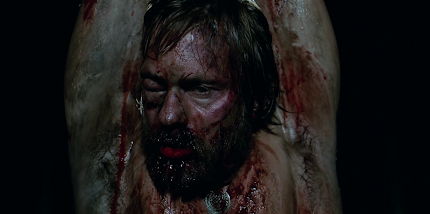
When The Northman begins, Amleth - the Viking Prince who will soon consign his life to the pursuit of vengeance - is still a boy. His father, Ethan Hawke's stout King Aurvandill War-Raven, returns from conflicts abroad with a seeping injury, one that seems likely to expediate the guileless prince's path to the throne. When considering his child War-Raven lasers in on Amleth's innocence; he senses something pure and uncorrupted in this cossetted, wide-eyed adolescent. Traits, incidentally, that this King feels are incompatible with the brutal monarchy that War-Raven has upheld. Despite protestations from Nicole Kidman's Queen, the father and his son partake in a ceremony designed to hasten Amleth's creep into adulthood. It's a shamanic ritual, resided over by Willem Dafoe's court fool, in which the two royals strip naked, bray and fart like animals, then drink mead spiked with a hallucinogenic. This witchery allows the pair to grasp at ethereal, reality-defying, visions that position their family within a massive tree root that extends off into distant futures.

Immediately following this psychedelic service, War-Raven is set upon and killed. Amleth escapes but never recovers from this outrage. His identity and outlook are frozen in the moments that he watched, helpless, as his father was murdered and his mother was carried away as plunder. Amleth therefore never quite shakes off the spell that was cast over him in that smoke-choked hut. The animal aspect that was summoned is never corrected by a return to the patterns and rhythms of a courtly life. The oath he swears during his escape - to avenge his father and free his mother - becomes an all-consuming ideological fulcrum. A desire for correction now burns within Amleth. The emotion has swallowed him whole, feeding the slathering, amoral might that lurks within. It's obvious then that The Northman owes John Milius and Oliver Stone's Conan the Barbarian a massive structural debt. Writer-director Robert Eggers and co-writer Sigurjón Birgir Sigurðsson treat that 1982 sword and sorcery film as a blueprint, battering a Scandinavian legend until it pivots on similar beats. Flourishes and embellishments are applied to Milius' sacred text: so while Conan steals a bastard sword away from a trembling Atlantean mummy, in Amleth's tale the corpse actually rises, joining battle with its graverobber.

The years between Amleth's flight and an opportunity to enact his revenge are a blur of frenzied violence. The prince - now played by a strapping Alexander Skarsgård - is a mercenary working with a clan of Viking berserkers. Pointedly, Amleth is party to, but not directly involved in, a kind of casual atrocity that undermines the conceptual purity of his own personal quest. His band generates enmity on a tremendous scale, tearing children and babies away from their screaming mothers then burning them alive. Skarsgård communicates a sheepishness in these scenes; an understanding that he is a component in a machine that perpetuates the kind of misery that drives his own vendetta. Later when Amleth has lied his way into a position that allows a chance at retribution, real-life circumstances gnaw away at his fantasy. The Wagnerian torment he has given his life over to is repeatedly undermined. First by the diminished circumstances he finds his treacherous uncle in, later by the poison that drips from his own mother's mouth. Eggers and Sigurðsson never let us forget that, in his heart, Amleth is a thwarted child. Jealousy prickles when he sees his mother loving another son and he willingly suffers through months of slavery just to decode a familial affection that he himself has never experienced. The final act of The Northman sees Amleth sinking deeper and deeper into delusion as a response to the devastating truths that assault him. The form of the film twists and turns in sympathy, rejecting muddy historical reality in favour of supernatural reverie. 

Tuesday, 22 March 2022

Spider-Man: No Way Home


Heavily indebted to Bob Persichetti, Peter Ramsey and Rodney Rothman's excellent Spider-Man: Into the Spider-Verse, Jon Watt's multi-dimensional pile-up, Spider-Man: No Way Home, employs the same reality-bending as its animated predecessor - not to mention the current Marvel streaming shows - to give this increasingly disconnected sub-series (as well as long-time executive producer Avi Arad) a victory lap. In doing so, No Way Home batters Tom Holland's likeable take on Peter Parker out of his moneyed comfort zone to re-establish a balancing act minted in a previous Spidey phase. The film abandons the overloaded technological wish-fulfilment - that saw Spider-Man subordinated into the role of Iron Man's teenage ward - to push at the working class ache that underpinned Sam Raimi's take on the character. No Way Home drags in adversaries from these Raimi films, as well as the two Marc Webb instalments that followed, as a way to brute force Holland's Parker through this conceptual shake-up. 

No Way Home is a piecemeal experience then. Strange highlights - imported from different films and deployed to wrinkle recognition - struggle to exert themselves on a whole that seems to be either thrashing around in the midst of an onscreen identity crisis or simply holding the Spider-Man character to ransom ahead of the next round of financier negotiations. Willem Dafoe's Green Goblin is an obvious but under-explored delight though. The character's trajectory built around the tensions of a personality split that, unfortunately, we barely see overlap. Still, even if No Way Home doesn't apportion enough screentime to Osborn to manufacture a believable (or even trackable) sense of mounting disquiet, the film does remember that the action in the first Spider-Man's was defined by a deeply personal strain of violence. While the weight that Watts and his screenwriters (Chris McKenna and Erik Sommers) heap on their hero never comes close to matching the face-swelling welts that Raimi dished out, Holland does get to play murderous rage: punch after punch, hammering down on the teeth of a clearly ecstatic Goblin. For a series of films in which (comfortably) billions of people have died, the motivational power of pure hatred is a note that has been largely absent.