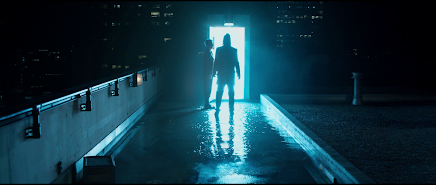
Even without the knowledge that director Oliver Hirschbiegel's original cut of The Invasion was deemed too dull by producer Joel Silver (then taken back to the drawing board by new writers Lana and Lilly Wachowski, as well as reshoot director James McTeigue), the finished product betrays an obvious feeling of bifurcation. Once a rolling start is packed away to be returned to later, introductory scenes are icy and tinged with misanthropy, as if preparing to detail a microscopic invasion using the syntax of a self-satisfied political thriller. Despite the dryness of the acronyms firing around, Nicole Kidman's prescription dispensing psychiatrist is shot to be luminous; cinematographer Rainer Klausmann arranging the frame around the light and heat rolling off this star. In the non-harried pieces of the film that can (presumably) be attributable to Hirschbiegel, Kidman betrays the blonde, Hitchcockian glamour of a Tippi Hedren or a Kim Novak. Later, when the film has defaulted to a checkpoint sprint with dozens of drone people hanging off a speeding sedan, Kidman is green and frazzled. Sunken deeply into a diet of Mountain Dew and pearlescent poppers as she struggles to stay awake. The Invasion then is trapped between these two clashing wavelengths: one frequency tuned to the buttoned-up description of a planet plunging into somnambulism. The other a much trashier take on human paranoia that allows Kidman's Dr. Carol to subject neighbourhood children to alarming head trauma or mow down advancing supermarket employees while her perspective slips in and out of focus. Neither element feels entertaining enough to really stake a claim on this film though. Instead, the two incompatible tones work against each other, undermining this strangely pod positive piece.
Showing posts with label The Wachowskis. Show all posts
Wednesday, 23 October 2024
The Invasion
Labels:
Daniel Craig,
Films,
James McTeigue,
Nicole Kidman,
Oliver Hirschbiegel,
The Invasion,
The Wachowskis
Thursday, 23 December 2021
The Matrix Resurrections
Credit to Lana Wachowski, it takes a certain amount of bravery to attempt a fourth entry in The Matrix series during a pandemic with a drastically shortened production cycle and an army of key collaborators off the board. As well as Lana's sister and co-writer-director Lilly Wachowski, The Matrix Resurrections misses both the gravitas conferred by Laurence Fishburne and the alien jeopardy that radiated from Hugo Weaving. Despite the absence of these actors their characters remain - one rejuvenated into self-satisfied nanotechnology whose big, plugged-in scene lands like farce; the other given the handsome-but-dull affect of the American ruling class. Alarmingly, these truancies extend beyond the screen into the technological and conceptual arena too. Bill Pope's (constantly quoted) sulphurous chiaroscuro has been overwritten here with a mode of visual communication that is often indistinguishable from streaming service television. A decision that, in fairness to this film's central conceit, is genuinely evocative of an artificial construct circling the drain.
The most dispiriting point of departure for Resurrections though is how the film handles its action. Fight choreographer Yuen Woo-ping was not retained for this fourquel, the decision (or restriction given that Yuen is deep into his seventies and very likely at least semi-retired) limits not just the movements that have been drilled into the cast but the angles the filmmakers then use to communicate arching limbs and the resulting impacts. The Matrix didn't just vary the speed of reality when employing its time slice visual effects. Bodies hammered each other in violent, exaggerated, flurries; fists detonated concrete structures in beatific crawls. Although Resurrections revisits these ideas, there's no attempt to build on them. The majority of the film's hand-to-hand action instead resolving to a deliberately obscured askance. Where previously we were asked to consider the ways in which super-powered bodies relate to each other - not just in terms of combat, but the twisting poses and power displays that might denote annoyance or one expert's assured tranquility - here these battles are punctuation, deployed to massage the transition between scenes. Basically, these (admittedly older) characters are no longer expressing themselves physically.
What Resurrections does have though is Carrie-Anne Moss, Keanu Reeves and an on-screen longing between the two that has only deepened with age. Reeves' Thomas Anderson is trapped in the medicated funk of corporate game development, forced to deliver a much delayed sequel to his biggest most wonderful hit. Although Resurrections' frequently features enormous, projected clips from the previous Matrix films, everyone in-universe points at these illuminations and identifies them as games. Apparently the interactive full-motion video titles associated with the Philips CDi or Sega's Mega-CD were a seismic success on this particular server? Trinity is similarly confined by middle-class domesticity; kept busy by an insistent, hovering husband and a pair of children portrayed as nothing more than ongoing irritants. The pull between Neo and Trinity then is initially contextualised as that of an affair: an exciting, instantaneous connection between two disappointed adults. Since Resurrections suffers horribly the further apart this couple are, it's therefore tempting to imagine a smaller scale instalment that completely forewent the technological ambitions of a big budget action film to concentrate on a bubbling infidelity in a counterfeit world. A Brief Encounter by way of The Wachowskis' own Bound.
Labels:
Carrie-Anne Moss,
Films,
Keanu Reeves,
Lana Wachowski,
The Matrix,
The Matrix: Resurrections,
The Wachowskis
Monday, 4 June 2018
The Matrix Revolutions
A shorter, almost supplementary experience compared to the previous instalments, The Matrix Revolutions discards the churning narrative ploys of The Matrix Reloaded to detail a war being fought on two intersecting fronts. Keanu Reeves' Neo moves in and out of the virtual world, meeting adorable refugee data and Bruce Spence's destitute jailer before parlaying with the screaming, shape-shifting, face at the centre of the machine city. While those two super beings chat it out, Zion loads its less interesting citizens into powered armour to vanquish an army of mechanical cephalopods who whoosh and swirl with the fluid grace of a 90s screen-saver.
Despite a city-shaking showdown with Hugo Weaving's powered-up Alpha Smith (complete with a rain-lashed mise en scene lifted from Lee Myung-se's Nowhere to Hide), Neo's story largely involves the messianic hacker beating a path, voluntarily, to the oblivion he avoided at the end of the first film. The Matrix proposed a clear demarcation between Neo's physical and digital identities. His human body was frail and emaciated after a lifetime bobbing around in synthetic amniotic fluids, while his data self skewed idealised. Neo imagined himself as lithe and festooned with pistols; dressed for war in a billowing trench coat and a pair of sunglasses that render his brow permanently furrowed.
Thomas Anderson's projected self resembled one of Peter Chung's Liquid Television characters; a human stick insect, ambulating around in-coming bullets fired by terminal suits. Revolutions obscures the disconnection between these sibling personas with a version of Neo that tests the boundaries between human and machine. He is a marked, actualised, saviour able to effect change both in and out of the prison code. Neo as an errant bug who has defied repeated attempts to neutralise then organise the threat he presents. His anchor is Carrie-Anne Moss' Trinity. It is her singular, burning, love that has conferred clarity on Neo, allowing his fragile meat body to cast the mighty will he wields in The Matrix onto the higher, physical, reality the couple currently inhabit.
The backstory frothing at the edges of The Matrix suggested a war between mankind and its automated offspring in the binary terms of good and evil. The machine presence in mankind's digital shroud was one of choking, systemic, violence. Our human freedom fighters responded accordingly, hosing down bewildered rent-a-cops with German sub-machine guns lest they twist and transform into something more capable. At the close of The Matrix, Neo was an all-powerful fist poised to strike. By Revolutions this instrument of revelation has cooled into a bridge between the two warring factions; a mutation that combines qualities from each of Earth's tribes into a walking catalyst, driving itself towards detonation. Rather than eradicate, it turns out Neo's purpose was to unify.
Labels:
Films,
The Matrix,
The Matrix Revolutions,
The Wachowskis
Friday, 18 May 2018
The Matrix Reloaded
The Matrix Reloaded swaps its predecessor's carefully plotted reveals for a ticking time bomb, urging our heroes forward through a series of loosely connected set-pieces. A swarm (shoal? squad?) of robotic squid is tunnelling down into the Earth's core to murder the freed people of Zion. They must be stopped. While Harry Lennix's exasperated, stick-in-the-mud Commander Lock plots a unified, mechanised defence, his love rival Morpheus gathers the cool kids to put all of humanity's eggs in Neo's basket. Raised to the level of a superman at the end of The Matrix, Neo is the rootless heart of Reloaded, a reality-defying monster who has tasted limitless strength yet finds himself butting up against automated wheeler-dealers attempting to talk him down from his privileged position.
While it is commendable that the path The Wachowskis have chosen for their heroes is a little more complicated than a simple rehash of the previous film's leetspeak cop-killers, the messiness their abstractions invite leaves the film feeling acutely directionless, particularly in its first half. Early scenes deal with the wrong kind of exposition, details and directions that pile-up around organic opportunities for the kind of confrontation studios presume keeps an audience awake. Where The Matrix felt fresh and finely tuned, Reloaded reads as churning and overwrought, a rash of scenes desperately seeking some kind of unifying tone or performance. This disconnection is also felt in how Neo and Carrie-Anne Moss' Trinity conduct themselves in private. There is no change in their demeanour, no sense of a secret, jealously guarded interior to their relationship. Given ship rest, they stay buttoned up. Neo remains a distracted waif, while Trinity never shifts out of grim-but-determined.
Even the film's action takes a hit. Neo's newfound Godhood means interactions with basic enemies have a palpable sense of boredom. He isn't fighting for his life anymore, he's batting away the pathetic swipes of children. Again, it's a conceptually pure idea but not necessarily fun to watch. The much-trumpeted Burly Brawl between Mr Anderson and dozens of identikit Hugo Weavings quickly loses all sense of weight and collision, sputtering on as a boring tech demo of Keanu Reeves rendered as a computer generated doll who has lost his stuffing. Above all, Reloaded's fights lack bite. There's none of the sweaty headbutts or eardrum bursting claps that landed the first film in hot water with the British Board of Film Classification. The Matrix kept an emotional component in its fights. Combatants, regardless of whether they were human or data, expressed pain and frustration, allowing the viewer to get their teeth into a situation. Reloaded repeatedly fumbles this simple premise.
What Reloaded does have though is Lambert Wilson's aristocratic obstacle, The Merovingian, and an incredible freeway chase built around an extended cue of Juno Reactor's pulsing, propulsive, Mona Lisa Overdrive. Merovingian arrives just as the film threatens to go into terminal decline, puncturing the dour, humourless, proceedings with a grandstanding slice of smug. His verbal assault then tracks nicely into a feature set-piece refreshingly free from Neo's weary grandstanding. Morpheus and Trinity escort Randall Duk Kim's Keymaker across a seething Autobahn pursued by the police, three new (hunkier) Agents and The Merovingian's phantom muscle. The sequence manages to be both breathlessly entertaining and a better expression of each character's physical and psychological disposition than any other scene in Reloaded. Trinity flees relentlessly - whizzing back-and-forth, up and down the packed, panicking, lanes - ruthlessly attuned to the task at hand. Comparatively, Morpheus is a human roadblock, a surprisingly spry barrel-chest who plants his feet then refuses to budge.
Labels:
Films,
The Matrix,
The Matrix Reloaded,
The Wachowskis
Thursday, 17 May 2018
The Matrix
Considering the sheer weight of exposition required to get the audience up to speed, The Matrix really moves. Writers-directors The Wachowskis ration out their (relatively) hard science-fiction premise expertly, using paranoia imagery and a grab-bag of throbbing, pre-millennial, worries to tell the tale of a future in which mankind has been reduced to a bio-mechanical battery. Laurence Fishburne's Morpheus shoulders the majority of this burden. The actor prowls around mouldy sitting rooms, flashing mirrored eyes and a knowing Cheshire Cat grin while bombarding Keanu Reeves' spaced-out Neo with the swirling rhetoric of a fanatic.
While The Matrix's core concept takes some explaining, the film's through-line is refreshingly simple, recalling classic mythology. Old hand Morpheus believes Neo is The Messiah while the younger, scrawnier, man cannot believe he is so important. After a bittersweet meeting with Gloria Foster's all-knowing Oracle, Neo is able to compartmentalise the dreadful expectation that has been foisted upon him. Despite what he is being sold by his handler / master, Neo is now able to take himself out of the anointed one equation, subordinating himself to Morpheus' dream. So when Morpheus sacrifices himself to ensure his protege's escape, Neo hurls himself back into danger, convinced his life is expendable when judged against Fishburne's magnetic prophet. The development is basic and transitional, but self-sacrifice is a key trait when considering a hero.
Although The Matrix secured its place in the public consciousness with John Gaeta and Manex Visual Effects' fluid time-slice photography, watched today the effect that lingers longest is the pounding, pistolero crack of the film's one-on-one fight scenes. The Wachowskis and fight choreographer Yuen Woo-ping present both their heroes and villains as low-level super-beings crashing about a fragile, easily shattered, world. It's an effect shamelessly swiped from Mamoru Oshii's Ghost in the Shell films, where this pliability had more to do with the sheer tonnage inherent to a fully-mechanised secret agent. The sight of reality bending then breaking around our warring parties stresses a vivid and personalised physicality though, one almost entirely absent from the hyper-expensive films that have followed and attempted to iterate on The Matrix's success.
Thursday, 24 December 2009
Disaster Year 2006: Children of Men

Based on a PD James novel, Alfonso Caurón's Children of Men believably portrays a certain kind of society shuffling towards extinction. The human race has been sterile for nearly two decades, affecting a worldwide mindset of total nihilism. Eye-catch news snatches shorthand a variety of global catastrophe, including a throbbing mushroom cloud on the New York skyline. The only country apparently left functioning is mainland Britain, which has devolved into a muddled fascist extermination state.
The frame crowds with rotting cages and temporary internment facilities, full of depressed peoples in the process of liquidation. Wake-up newscasts are preceded by chummy infomercial ads for government issued suicide pills. Grasping terror cells bomb cafés for anti-establishment lip-service. Something terrible has happened in Liverpool. The British populace sleepwalks through the misery, crowding their desks with vile trinkets, and blubbing about celebrity deaths. It's a post-apocalyptic Blitz spirit tempered with an acute emotional repression, and pigheaded inflexibility. Everybody still shuffles into their awful cubicled workplace; despite Bexhill's transformation into a smoking death camp, capital nights are still spent down the pub. While the rest of the world has exited in a rationalised orgy of self-immolation, this country stockpiles works of art and worries if there will be anybody left to appreciate them. Britain maintains. Children of Men is bold and telling where the Wachowski's anaemic adaptation of V for Vendetta, issued the same year, is simply puny.
Labels:
2000 - 2009,
Alfonso Caurón,
Children of Men,
Favourites,
Films,
The Wachowskis,
v for vendetta
Thursday, 17 July 2008
Woah! I is Plastic!
Various sources are reporting that the Wachowskis are looking to resurrect their 1990s Plastic Man script for their next feature. Rolly polly mouthpiece for the brothers Joel Silver was recently heard talking the project up on German radio, he also revealed Keanu Reeves is sought for the lead.
Plastic Man concerns one Eel O'Brian, a petty hood that gets shot-up and doused with acid. Nursed back to health by a kindly monk, Eel discovers the acid has given him the capability to transform his body into any shape he can conceive. Imagine that! Slapstick crime-fighting ensues. Given the kaleidoscopic eye-treat nature of the Wachowski's latest: Speed Racer, I'd say a surrealist body-morph crime-fighter was right up their crime alley.
My fingers are now crossed!
Wednesday, 7 May 2008
They Lingered There...
More summer film spam.
WALL-E 1
A cute little slave robot potters around a rubbish (garbage, not qualitative) planet tidying up. Riveting! By the looks of it, Wall-E will be a environmental parable about mankind's destructive legacy. I'll wager there's some unrequited love in there too. Wall-E himself looks like a mechanical ET by way of Short Circuit's Johnny 5, all squashed up and super deformed (Japan, beware) for toy markets. Thankfully, it's against Pixar law for their films to be sub-par. It's rumoured that both Cars and Ratatouille stunk up the place in their original forms before substantial delays and superstar directors were drafted in to salvage the projects. The most exciting news about Wall-E is the involvement of sound design superman Ben Burtt - he designed basically any noise you hear in any of the Star Wars films. Mr Burtt is recording 'voices' for the robots, these will no doubt be all manner of interesting blips and clicks. I am not being sarcastic. I find that exciting.
Speed Racer 1
The big action offering from the now resolutely gender non-specific Wachowskis. No doubt only vaguely based on Tatsuo Yoshida's (also responsible for Gatchaman / Battle of the Planets and Casshan) manga Mach GoGoGo, instead formed from a collective nostalgic bubble thought about the late 60s (limited) animation series. Judging by the trailers, Speed Racer is a madcap Spy Kids 3 alike with visual overtones suggestive of Mario Bava's Danger: Diabolik and Mariho Maeda's kaleidoscope Count of Monte Cristo animated series: Gankutsuou. Phew! Add a heaped tablespoon of candy-colour Hot Wheels loop de loops, and a Chimp (oh yes), and you might be somewhere close to how excited I am. Hopefully the sleeper "awesome!" film of the summer. The Wachowskis demonstrated a firm understanding of car crash clap prompts in Matrix 2, successfully apeing and extending ideas from the Godfathers of sci-fi car crashin': Mad Max 2: The Road Warrior and Terminator 2. No-one else I know is even slightly interested. I shall go on my own if need be!
Hulk 2
Ang Lee's film wasn't quite good enough apparently. Oh well I thoroughly enjoyed it. Edward Norton heads up this instead-of-quel, which again seems patterned towards nostalgia - the first trailer was dripping with boring "remember how much you loved this when you were 5!" visual cues from the Bill Bixby TV series. As is routine with his projects, Norton has his grubby mitts all over this, not only acting but script re-writing too (probably bullied the director to death as well). Norton's presence is undoubtedly a positive though, without him this re-boot of Jack Kirby and Stan Lee's Hyde monster would seem all-sop to the TV series. Disappointingly though Hulk's birth through medicinal Gamma radiation application is retained, rather than the original comics caught-in-an-atomic-explosion womb. Hulk himself looks darker and nastier than Ang Lee's chubby child muscler - Norton Hulk is patterned after an in-house design I can't ascribe a particular artist too, that was popular in the 80s. He looks mean. Shame the big bad Abomination looks like you typical crude video game bruiser (Gears of War's Berserker most especially). Notron's Banner is wire thin and sporting a goatee, he looks like your typical seething neurosis driven Steve Ditko render. Norton would've made an excellent Dr Strange. We have missed out.
Hellboy 2
After the fun but uninspiring first stab at Mignola's baby, Guillermo Del Toro returns with a hidden nation clash that looks much more in keeping with his oeuvre. It's Ron Pearlman vs all manner of supernatural children of the earth. Take that elves! Departing rapidly from the comic series' plotlines is probably for the best, not because the comics are in any way anything other than superb, rather it allows Del Toro to flex his own considerable imagination gland without having to reign himself in to fit a prescribed narrative. The undernation teased in the trailers is the Fairy kingdom of Del Toro's Pan's Labyrinth in all but name, it'd be pulp perfect to see the big red beast of the apocalypse vandal his way through, dropping quips and chumps left and right.
WALL-E 1
A cute little slave robot potters around a rubbish (garbage, not qualitative) planet tidying up. Riveting! By the looks of it, Wall-E will be a environmental parable about mankind's destructive legacy. I'll wager there's some unrequited love in there too. Wall-E himself looks like a mechanical ET by way of Short Circuit's Johnny 5, all squashed up and super deformed (Japan, beware) for toy markets. Thankfully, it's against Pixar law for their films to be sub-par. It's rumoured that both Cars and Ratatouille stunk up the place in their original forms before substantial delays and superstar directors were drafted in to salvage the projects. The most exciting news about Wall-E is the involvement of sound design superman Ben Burtt - he designed basically any noise you hear in any of the Star Wars films. Mr Burtt is recording 'voices' for the robots, these will no doubt be all manner of interesting blips and clicks. I am not being sarcastic. I find that exciting.
Speed Racer 1
The big action offering from the now resolutely gender non-specific Wachowskis. No doubt only vaguely based on Tatsuo Yoshida's (also responsible for Gatchaman / Battle of the Planets and Casshan) manga Mach GoGoGo, instead formed from a collective nostalgic bubble thought about the late 60s (limited) animation series. Judging by the trailers, Speed Racer is a madcap Spy Kids 3 alike with visual overtones suggestive of Mario Bava's Danger: Diabolik and Mariho Maeda's kaleidoscope Count of Monte Cristo animated series: Gankutsuou. Phew! Add a heaped tablespoon of candy-colour Hot Wheels loop de loops, and a Chimp (oh yes), and you might be somewhere close to how excited I am. Hopefully the sleeper "awesome!" film of the summer. The Wachowskis demonstrated a firm understanding of car crash clap prompts in Matrix 2, successfully apeing and extending ideas from the Godfathers of sci-fi car crashin': Mad Max 2: The Road Warrior and Terminator 2. No-one else I know is even slightly interested. I shall go on my own if need be!
Hulk 2
Ang Lee's film wasn't quite good enough apparently. Oh well I thoroughly enjoyed it. Edward Norton heads up this instead-of-quel, which again seems patterned towards nostalgia - the first trailer was dripping with boring "remember how much you loved this when you were 5!" visual cues from the Bill Bixby TV series. As is routine with his projects, Norton has his grubby mitts all over this, not only acting but script re-writing too (probably bullied the director to death as well). Norton's presence is undoubtedly a positive though, without him this re-boot of Jack Kirby and Stan Lee's Hyde monster would seem all-sop to the TV series. Disappointingly though Hulk's birth through medicinal Gamma radiation application is retained, rather than the original comics caught-in-an-atomic-explosion womb. Hulk himself looks darker and nastier than Ang Lee's chubby child muscler - Norton Hulk is patterned after an in-house design I can't ascribe a particular artist too, that was popular in the 80s. He looks mean. Shame the big bad Abomination looks like you typical crude video game bruiser (Gears of War's Berserker most especially). Notron's Banner is wire thin and sporting a goatee, he looks like your typical seething neurosis driven Steve Ditko render. Norton would've made an excellent Dr Strange. We have missed out.
Hellboy 2
After the fun but uninspiring first stab at Mignola's baby, Guillermo Del Toro returns with a hidden nation clash that looks much more in keeping with his oeuvre. It's Ron Pearlman vs all manner of supernatural children of the earth. Take that elves! Departing rapidly from the comic series' plotlines is probably for the best, not because the comics are in any way anything other than superb, rather it allows Del Toro to flex his own considerable imagination gland without having to reign himself in to fit a prescribed narrative. The undernation teased in the trailers is the Fairy kingdom of Del Toro's Pan's Labyrinth in all but name, it'd be pulp perfect to see the big red beast of the apocalypse vandal his way through, dropping quips and chumps left and right.
Labels:
guillermo del toro,
hellboy,
hulk,
jack kirby,
mike mignola,
pixar,
speed racer,
steve ditko,
The Wachowskis,
wall-e
Subscribe to:
Posts (Atom)